The most useful points from this guide before you continue.
Stay on Vršič Pass
Stay at Erjavčeva koča on Vršič Pass
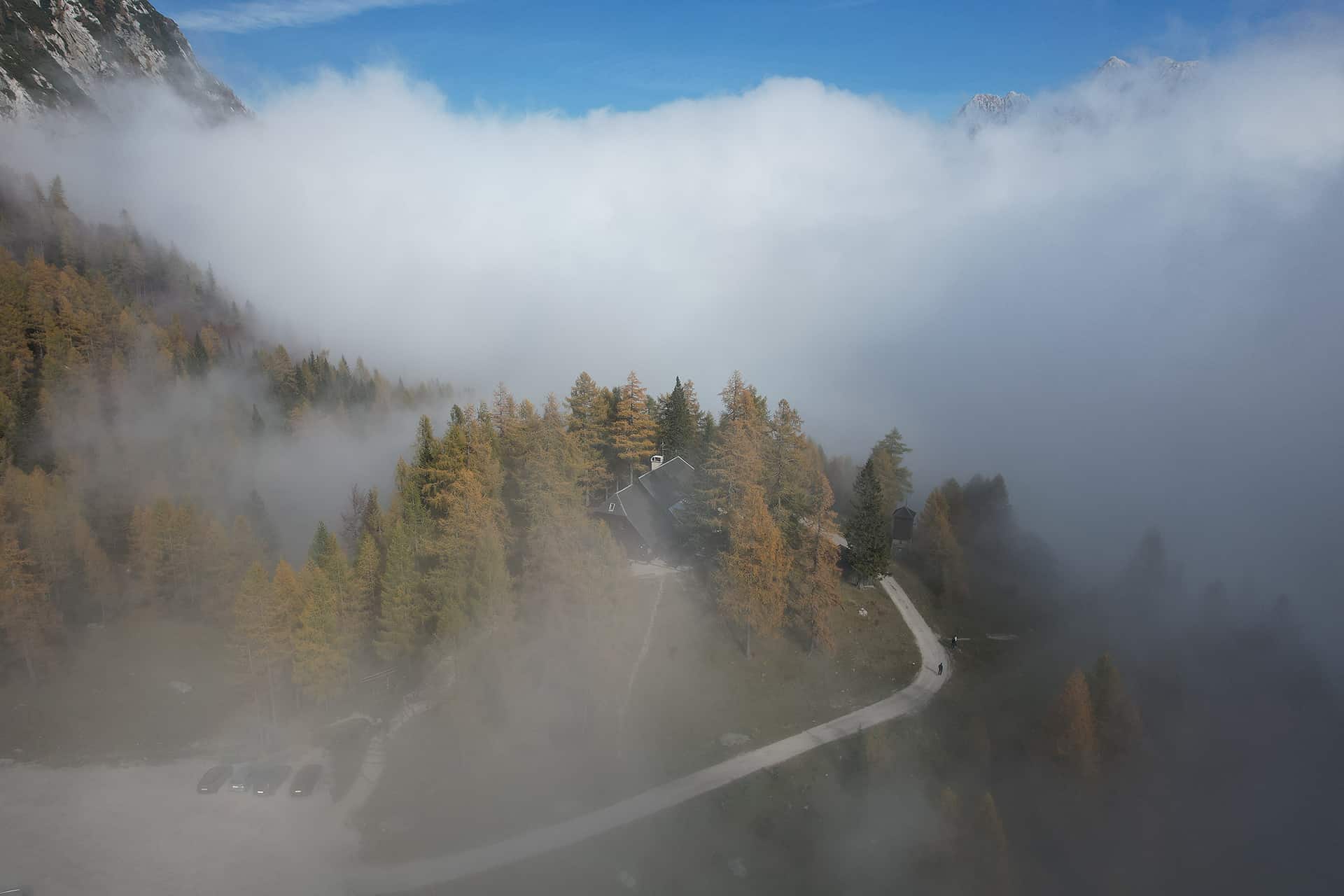
Erjavčeva koča is a mountain hut at Vršič Pass, between Kranjska Gora, Trenta, the Soča Valley and the Julian Alps. It is a practical base for hikers, road-trippers, cyclists and guests who want to stay close to the mountain pass.
Direct location on the Vršič Pass road
Good base for hiking, scenic drives and Julian Alps day trips
Useful for guests visiting Kranjska Gora, Trenta, Soča Valley and Triglav National Park
Food, mountain-hut atmosphere and practical local information in one place
This block is designed for independent guests and self-service booking. It does not imply a price guarantee or live availability.
Before you book your stay
Vršič Pass is a high mountain location, so it is worth checking a few practical details before you travel. This helps you plan your arrival, parking, hiking day and overnight stay more easily.
Access and road conditions
The Vršič road can be affected by season, weather and traffic. Before travelling, check current access information and plan enough time for the mountain road.
Parking
Parking rules and availability around Vršič can change by season and operator. Check the latest parking information before arrival, especially in busy periods.
Rooms and overnight stay
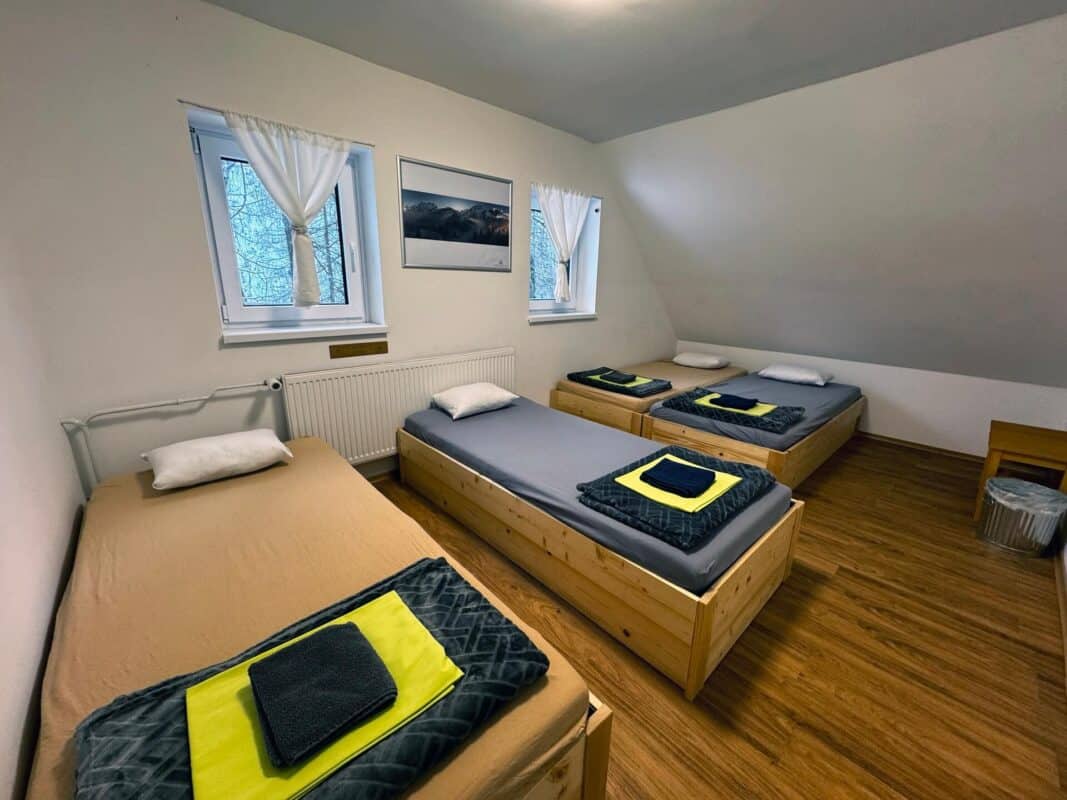
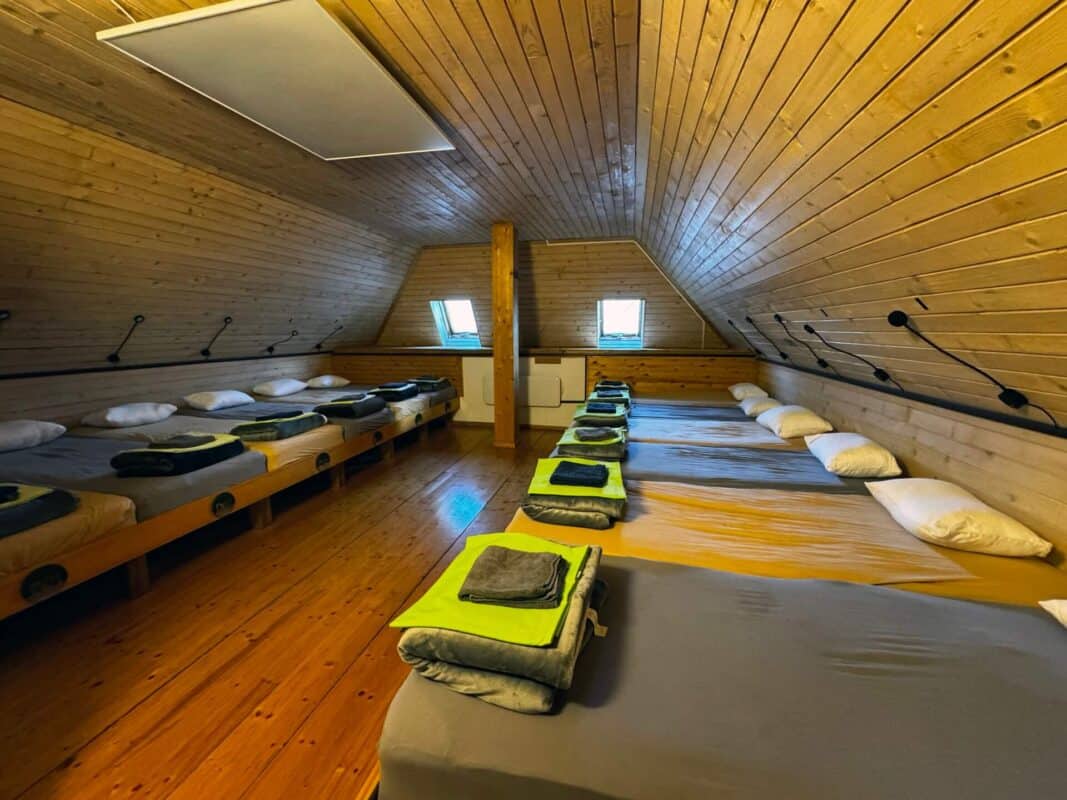
If you plan to stay overnight, check room availability in advance. This is especially important during the hiking season, weekends and good-weather periods.
Food, opening hours and groups
Opening times may vary outside the main summer season or by arrangement with groups. Contact the hut directly for the latest information before making fixed plans.
Self-service planning for your stay at Vršič Pass
Check room and availability options first.
Read access, parking and arrival notes before travelling.
Arrive with your own plan for Vršič, Kranjska Gora, Trenta and the Soča Valley.
Use contact only for special cases, not for information already explained on the page.
A trusted mountain hut at Vršič Pass
Erjavčeva koča has been part of the Vršič mountain pass experience for generations. Guests use it as a practical alpine base for hiking, cycling, scenic drives, visits to Kranjska Gora and trips toward Trenta and the Soča Valley.
Erjavčeva koča is a mountain hut at 1525 m, not a hotel or hostel. Come for nature, simple shelter and the rhythm of the mountains.
✓Expect
✓Direct access to Vršič, trails and Triglav National Park
✓Quiet evenings, early starts and weather-dependent mountain life
✓Food, shelter and practical help from the hut team
✓Unspoiled nature, mountain views and fresh alpine air
×Do not expect
×Perfect silence during busy mountain days
×A valley resort experience
×Luxury hotel rooms or city-hotel services
×Hostel-style nightlife or loud late evenings
Before you book your stay at Vršič Pass
Use the booking information on this page to decide independently. Booking platforms can help with comparison, but your reservation should be clear before you travel. Contact is only for special cases.
Direct booking is best for
Checking rooms and availability
Reading access, parking and arrival details
Booking when your dates and plan are clear
Special questions only for groups, late arrival or winter conditions
No price guarantee is implied. This block encourages self-service planning and reduces unnecessary calls or emails.
What happens after you check availability?
Checking availability is the first booking step, not a request for personal travel planning. Read the arrival, access and parking information before you book. Contact is only for special cases.
Choose the room or stay option that fits your plan.
Complete the booking request with your travel date and arrival plan.
Before travelling, read the access, parking and seasonal notes; use contact only for groups, late arrival or winter conditions.
CTA clicks are measured as intent signals. This block is designed for self-service reservations and to reduce unnecessary calls or emails.
Summer visit: parking, hiking and rooms
In summer, Vrsic is busy with hikers, cyclists and scenic-road visitors. Plan arrival time, parking, weather protection and overnight questions before you leave.
Arrive early when parking demand is high.
Check weather before longer hikes.
For overnight stays, contact the hut directly before travel.
This block is a practical planning reminder, not a live availability statement.
This guide is prepared from the perspective of Erjavčeva koča, a mountain hut on Vršič Pass. Use it together with current weather, road conditions and responsible behaviour in Triglav National Park.
Last updated: 08/02/2026First published: 08/07/2025Reading time: 15 min readPrepared by: Erjavčeva koča team
The Centenary of the Avalanche below Vršič
The Centenary of the Avalanche below Vršič
The Centenary of the Avalanche below Vršič
White Death Reaps among Russian Prisoners
Miha Pavšek
(pp. 10–15)
At the beginning of March this year, one hundred years have passed since the so-called “Russian” avalanche beneath today’s Vršič Pass (1,611 m) in the Julian Alps. It was one of the largest and best-known avalanche disasters in the territory of present-day Slovenia, and in recent decades it has been regularly commemorated by a ceremony at the Russian Chapel. According to various sources, the disaster claimed from just over one hundred to several hundred lives, most of them Russian prisoners of war. In just a few months, these prisoners had built this important transport connection and then maintained and serviced it. Among the victims were also soldiers and officers of the Austro-Hungarian army.
By the number of casualties, this was not the deadliest avalanche disaster on Slovenian territory during the First World War. The construction of the Vršič road itself claimed far more victims than avalanches. In this article, we examine in greater detail the causes and consequences of this major tragedy. According to some estimates, snow avalanches in the Alpine region during the “Great War” claimed around fifty thousand lives on both sides of the conflict. As a result, the global conflict also came to be known as the “White War.”
The Centenary of the Avalanche below Vršič
Avalanches Did Not Strike Only at Vršič
Because of the mountain road’s accessibility and year-round passability, Vršič has long been a popular starting point for tours of all kinds and levels, even in winter conditions. The pass takes its name from the peak of the same name, just under 130 meters higher, north of the Poštarski dom (Postmen’s Hut). Over the past century, many stories have become associated with it. One of the most tragic events occurred in the first months of 1916, when traffic began to run along the road. It is therefore fitting, as part of the centenary commemorations of the First World War, that we also remember those tragic events in our central mountaineering journal.
The avalanche disaster beneath Vršič a hundred years ago offers an opportunity to recall and reflect on some lesser-known details of that European-scale conflict. At that time, this area also had permanent settlement. Soldiers from both sides found themselves in a mountain landscape, on combat positions in the harshest possible conditions—winters rich in snow and cold. Overnight-recruited “lowlanders,” some of whom had never even dreamed of snow avalanches, were suddenly confronted with a harsh, unknown, and remote environment. For their superiors, the logistical and tactical organisation of warfare in such conditions was also largely uncharted territory. Although all participating armies had special mountain units, only a few had real experience in mountain warfare.
A particular chapter in this story concerns the many prisoners of war who were forced into back-breaking labour under impossible conditions. According to some data, more soldiers died from avalanches in the Alps than from firearms. In Slovenia, there were even more avalanche victims than at Vršič—along the Isonzo Front and in the Western Julian Alps, as well as in parts of the Eastern Alps, especially the Dolomites.
The Centenary of the Avalanche below Vršič
(1) Russian prisoners of war building stone retaining walls and carrying stone. Source: Europeana
Unprepared for Demanding Winter Conditions
In most previous wars, participants had not encountered avalanches, since the fighting occurred in snow-free conditions or under negligible snow cover, and on gentler terrain. In addition to soldiers, many civilians in the rear areas also fell victim to avalanches while engaged in “war-related” tasks. Human madness even went so far that, according to some sources, avalanches were deliberately triggered with artillery and mortars above enemy positions and used as a (literally) cold weapon. It was in this period that the term “white death” emerged, a phrase still frequently encountered in the media describing large-scale avalanche disasters.
Pavel Kunaver, author of the first mountaineering manual Na planine (“To the Mountains”), which emphasises the importance of prevention in avalanche accidents, wrote in one of the Planinski vestnik issues of the 1920s that “in many places stubborn and uninformed commanders drove people straight into the embrace of white death.”
Before the First World War, weather observation already existed in some places, but mostly only in larger cities. The Italian army quickly recognised the importance of observing and recording snow phenomena and weather conditions in the Upper Soča region, while on the Austro-Hungarian side, little attention was paid to this. Interestingly, we have almost no data from this period on accidents on the Italian side of the front, even though, according to some estimates, the total number of avalanche deaths on the Isonzo Front was even higher there than on the Austro-Hungarian side.
By contrast, for smaller avalanche accidents involving Austro-Hungarian troops, we even have nominal lists of victims, though this does not apply to the so-called Russian avalanche (in reality, several avalanches in March 1916). In the wider Isonzo Front area, nearly forty avalanche disasters are recorded, in which—according to sources of varying reliability—almost 1,400 soldiers and prisoners of various nations and ethnicities died (at least 1,000 of them on present-day Slovenian territory).
During the 1915/16 snow season, there were not many avalanches until March. Then an enormous amount of new dry snow fell, followed by a gradual thaw. Several earlier, smaller incidents in early March 1916 foreshadowed the subsequent major avalanche beneath Vršič.
Franc Uran vividly described the power of the avalanches that swept past Erjavčeva Hut, carrying remnants of wooden galleries:
“Individual broken and toppled beams looked as if they were matchsticks, everything else as if it were made of paper.”
The Centenary of the Avalanche below Vršič
(2) View of the German Voss Hut (today Erjavčeva Hut on Vršič). To the right of it were the prisoners’ camp, a bakery, an infirmary, and a telephone exchange. The levelled terrain is still clearly visible today. Source: Europeana
Weather Conditions Leading to the “Russian” Avalanche
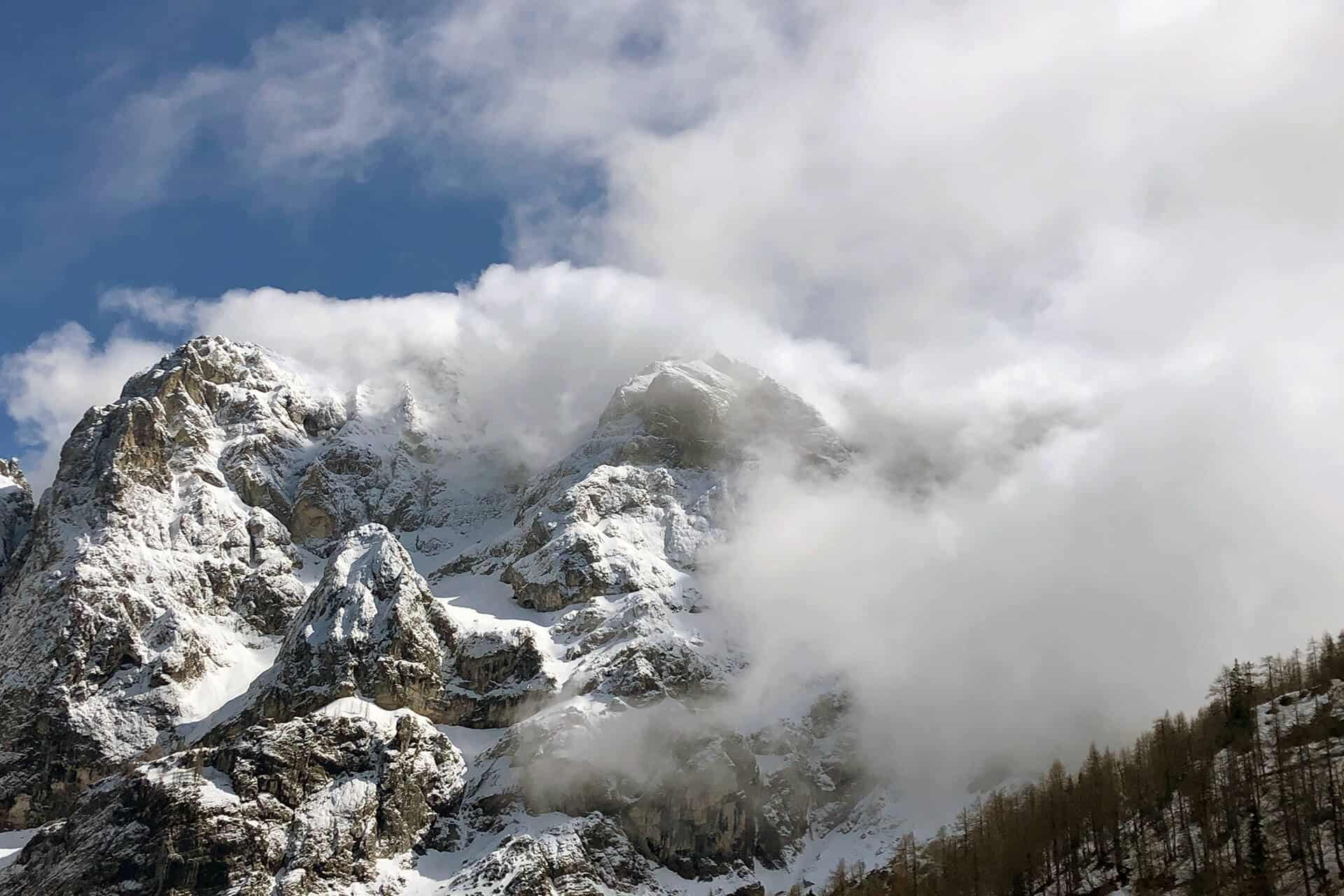
An examination of the weather situation at the time shows that snowfall began at the end of February, when a deep trough moved over Western Europe. On its leading (western) side, a deep cyclone formed, later followed by a smaller secondary one centred over northern Italy. It was this latter system that brought heavy precipitation to the Julian Alps. While cold air persisted at higher altitudes, snowfall continued; during the night from 7 to 8 March, however, the snow turned to rain everywhere except near the surrounding peaks. The thaw most likely triggered large avalanches on Wednesday, 8 March, around one o’clock in the afternoon, sweeping across the southeastern slopes between Mala Mojstrovka (2,332 m) and Nad Šitom Glava (2,087 m), as well as from the scree slopes east of the latter.
These avalanches buried the military settlement (the northern Vršič camp, “Nordlager”) with Russian prisoners of war and Austrian guards, as well as extensive wooden avalanche-protection galleries several hundred meters long at the top of the pass (stretching from Močila on the pass to below Tičarjev dom). A second wave of avalanches four days later, on 12 March, destroyed the framework of the monument to Archduke Eugen at the top of the pass—after whom the road was named—as well as the two upper stations of the cargo cableway.
Between the two events, relatively warm and unstable weather with frequent precipitation continued, as the cyclone partially regenerated the day after the first major avalanches and its centre shifted over the central Adriatic.
The Centenary of the Avalanche below Vršič
(3) Group photograph of prisoners, their guards, and, in the foreground, Austro-Hungarian officers in front of the Russian Chapel, which the prisoners built in 1916 in memory of the several thousand who died during the construction of the road. Archive of the Museum of Contemporary History of Slovenia
Devastating Consequences of Enormous Forces
The galleries had been built by military authorities in 1915 and consisted of large, heavy wooden roofs and protective cladding. Above the barracks, they also constructed a large wooden bridge intended to divert avalanche debris. All this was described in detail by Franc Uran in his article How the Road over Vršič Was Built.
The initial avalanches were dry-snow avalanches that, as they progressed, set in motion surrounding masses of snow lying just above the pass, which had been saturated by rain. In the second wave, the avalanches were mostly wet-snow avalanches. Both types involved enormous forces—dry avalanches because of their great speed (100 km/h or more), wet avalanches because of their immense mass (300–500 kg/m³). The scale of destruction—uprooted mature trees, demolished wooden structures, and similar damage—testifies to extreme loads (estimated at over 10 t/m²).
The horror of the disaster is suggested by accounts that soldiers and prisoners who fled the scene all declared with one voice that they would rather be shot than return. Officers stationed at Tičarjev dom reported that the roof had been destroyed and the hut was empty. Larger-scale organised rescue efforts began only the following morning, although a group of Russian prisoners told the local commander that they would no longer work at Vršič, as it endangered their lives. Only a few prisoners were willing to go up to the pass, and Austrian engineers and officers were no less afraid.
Where the framework of Eugen’s monument, nearly twenty meters high, had stood the day before, nothing was visible anymore; only here and there did a broken beam or plank protrude from the avalanche debris. There was an enormous amount of snow, compacted and icy in places; the surrounding peaks were shrouded in fog, making it impossible to determine where the avalanche had originated.
Rescue Operations
Uran writes that at first no bodies were visible, as they lay deep beneath the snow. On the steeper western side of Tičarjev dom, where the avalanche came to rest (as it did in the mid-1970s), more than 3 meters of snow had piled up in front of the doors, which had to be dug out. Beneath them, two Russian prisoners were found who had died from the effects of the powder-snow blast wave. During their burial at Huda Ravna, south of Vršič, other prisoners realised that it would nevertheless be necessary to excavate the buried victims.
The work was exhausting, even though snowfall had temporarily stopped, as the avalanche debris was hard and in places icy. The first recovered victims—fifteen prisoners and one guard—were completely mutilated. Beams from the collapsed galleries had torn off heads and limbs, leaving no hope of finding survivors. Soon after, another avalanche thundered down, forcing rescuers to halt their efforts.
The burial of both cableway stations was also a logistical catastrophe, as traffic across Vršič came to a complete standstill. With communications cut, there were no clear military orders. This lasted almost two weeks, until the weather improved.
Uran himself was sent to the command in Kranjska Gora to obtain instructions.
Orders were issued to move all Russian prisoners down into the valley to Sveta Marija (the Church of Our Lady of Loreto in the Trenta hamlet of Pri Cerkvi) and house them in barracks, while technical personnel were to go to the Soča River in Trenta and await further orders. Today, we would describe Uran’s journey via Log pod Mangartom and the Rabelj tunnel, returning to Kranjska Gora by mining train, as quite adventurous, as it was accompanied by occasional gunfire near Kal Koritnica and in the darkened Rabelj due to the proximity of Italian forces.
The Centenary of the Avalanche below Vršič
(4) One of the burial sites is just below Erjavčeva Hut, where the victims of the snow avalanches in March 1916 are buried. Photo: Miha Pavšek
The Number of Victims Will Never Be Precisely Known
Upon his return to Kranjska Gora, Uran learned that according to official data, 110 Russian prisoners (including some Volga Germans) and seven Austrian guards had died. The parish chronicle of Kranjska Gora records 210 victims; some sources even mention 300, though these figures are less reliable. Among them were reportedly 170 prisoners and 40 guards.
The day after the first avalanche, a baker was found alive beneath the debris at the bread oven—the only masonry structure not destroyed. The victims were buried in Kranjska Gora, in the crypt near the Russian Chapel, at the military cemetery in Trenta, and in individual graves near the disaster site beneath Vršič. Among the dead was at least one Slovenian, Franc Peternelj, known locally as Peternelc, from Kranjska Gora.
The true number of victims remains unknown, as the Austro-Hungarian command kept the figures strictly secret during both rescue operations and later repairs.
Only on 3 April did Russian prisoners (the first group numbering twenty-five men) begin organised searches under the snow mass. The rescuers were hungry and intimidated, often forced at gunpoint to dig tunnels through the endless avalanche debris, several meters thick in places. There is a well-known story of how they broke through to the bakery through a small opening and found still-edible bread, three weeks old, exclaiming: “Khleb, khoroshó!” (“The bread is good!”)
The officers’ rescue base was in the then Voss Hut, while Russian prisoners stayed in barracks at Močila, which had remained intact. In the following days, additional prisoners, officers, and engineers joined the excavation work. Uran was assigned—because of the risk of further avalanches—as a “weather prophet,” assisted by a Tyrolean who also knew avalanches well. Together, they examined avalanche remnants and surrounding peaks. They found that cornices on the Mojstrovka ridge were still present and thus were not the main cause of the largest avalanches. The decisive factors were clearly the enormous amount of new snow and the subsequent thaw.
The Centenary of the Avalanche below Vršič
(5) View of the avalanche area above Vršič from below Gladki rob; to the left of Tičarjev Dom, the mountain pass is hidden. Photo: Miha Pavšek
The Russian Chapel
Clearing avalanche debris continued, and even horses had difficulty crossing it, sinking deeply into the snow. The problem was solved by laying the horses on their sides, tying their legs, and sliding them on a tent canvas, as on a toboggan, toward Močila, where they were caught and untied. Later that night, the well-known ground avalanche from Vratca (Slemeno) indeed came down, piling debris almost to the top of the hill on which Erjavčeva Hut (then Voss Hut) stands today. The avalanche also swept away the remaining wooden galleries into the ravine south of the hut and toward Suha Pišnica, further slowing rescue efforts. The last victims were recovered only in late spring, as some were buried more than ten meters deep.
Uran also notes instructively that because of the great need for timber during road construction, trees were felled everywhere along the route; as a result, avalanches in subsequent years also reached areas they had not before.
Finally, mention must be made of a lesser-known avalanche disaster involving Russian prisoners fourteen months after the March 1916 events. On Saturday, 12 May 1917, at 11 a.m., an avalanche from Mojstrovka (more precisely from below Grebenec) completely destroyed the southern Vršič camp (“Südlager”). Only on 3 June were thirty prisoners and six guards found and excavated.
The deaths of Russian prisoners in the rear of the front in March 1916 and May 1917 on both sides of the pass also contributed to the later naming of this route as the “Russian Road.” Perhaps we would not know of all these tragedies if Russian prisoners had not, in 1916 and 1917, built not only a stone crypt but also simple chapels with two onion domes above the eighth bend of the Vršič road, in memory of their compatriots. Today, this is known as the Russian Chapel, a protected cultural-historical monument and one of the twenty-three stations of the Slovenian section of the European Cultural Heritage Route. It is most visited on the last Sunday of July, when a commemorative ceremony is held and attended by the highest representatives of both countries.
The Centenary of the Avalanche below Vršič
(6) A snow avalanche engulfing Austro-Hungarian soldiers; their Italian opponents look on silently, with horror in their eyes. The double-page illustration was published on 27 May 1916 in the centre spread of The War Illustrated, which was published in London. Source: www.border-regiment-forum.com/
Tradition Strengthened Again
Such commemorations began between the two world wars; after the Second World War, they became rarer due to strained relations, but were revived after Slovenia’s independence in 1992. Since then, the annual ceremony has become one of Slovenia’s more prominent political events.
Both the catastrophic consequences and the lessons learned during the war later contributed to the establishment of research institutions within military structures in some Alpine countries, with the army as their patron and user. During the Second World War, specialists in snow avalanches were already active within mountain brigades. A comparison between the two world wars shows that in the later conflict, there was a far greater awareness of the “white danger.”
Regarding the Vršič avalanche and everything connected with it, it can be said that what occurred in the high Alpine terrain at that time was not the warfare of trained mountain troops, but a winter-limited slaughter akin to war. Fortunately, the war ended before the onset of the winter of 1918/19.
A century-long historical reflection today—perhaps more than ever—leads us again to the realisation that this conflict was a great absurdity, of which avalanche victims among soldiers and prisoners were also a part: people who were simply in the wrong place at the wrong time. In reality, while snow cover persisted in the high mountains, there were few direct battles or movements. The main struggle for the temporary inhabitants was survival in a harsh mountain environment whose peaks offered no hint of the gods’ presence, as they sometimes appear to us from the valley.
More about avalanche victims during the First World War can be found at http://www.100letprve.si/ under “Snow Avalanches and the First World War.”
The Centenary of the Avalanche below Vršič
Avalanche cadastre on a digital orthophotography of the Vršič area. Naming of avalanches: 1 – Mojstrovka, 2 – Na Močilih 1, 3 – Na Močilih 2, 4 – Vratca, 5 – Kamnitnica, 6 – Robičje 1, 7 – Robičje 2. The avalanche-protection galleries, which were intended to ensure that the road would remain passable even in winter, were built of thick wooden beams, but the force of the avalanche easily broke them. Source: Europeana
We are located in the heart of Triglav National Park
Book a stay in the iconic, first-built mountain hut on the Vršič Pass
Erjavčeva mountain hut is open year-round. Reserve your stay and spend some time in the natural paradise of Triglav National Park (UNESCO), near Kranjska Gora, on the Vršič mountain pass in the heart of the park.
We use cookies to improve your browsing experience, measure traffic, and enhance website functionality. You can accept all cookies, reject non-essential cookies, or manage your preferences. Cookie Policy,
Privacy Policy
and Terms of Use.
!
Google Maps displays incorrect information that the road to Erjavčeva koča is closed. The road to Erjavčeva koča is open and normally passable from both directions.



 Slovenščina
 Bosanski
 Hrvatski
 Čeština
 Dansk
Dansk Dutch
Dutch Suomi
Suomi Français
 Deutsch
 Magyar
 Italiano
 Polski
 српски
 Slovenčina
 Español
 Svenska