


 Slovenščina
 Bosanski
 Hrvatski
 Čeština
 Dansk
Dansk Dutch
Dutch Suomi
Suomi Français
 Deutsch
 Magyar
 Italiano
 Polski
 српски
 Slovenčina
 Español
 Svenska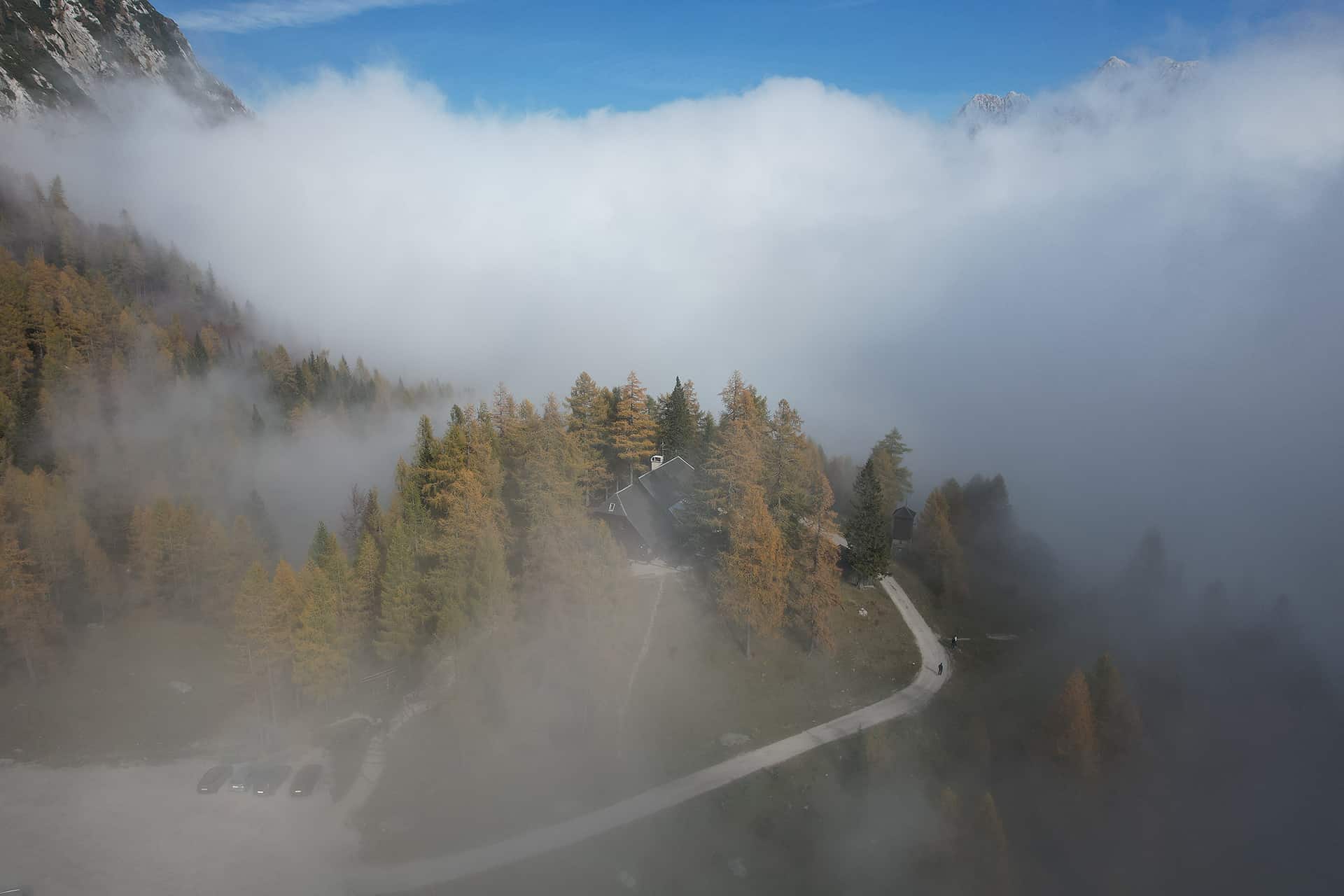
On this page
Jump to the most useful sections of this guide.
- Summer visit: parking, hiking and rooms
- 100 years since the Triglav Lakes Valley was first insured: a natural beauty that moves time and time again
- The Seven Lakes Valley Conservation Park
- Triglav National Park “Valley of the Seven Lakes”
- Triglav National Park
- Russian grave in the Triglav Lakes Valley
- Related mountain and travel guides
Quick summary
The most useful points from this guide before you continue.
Stay on Vršič Pass
Stay at Erjavčeva koča on Vršič Pass
Erjavčeva koča is a mountain hut at Vršič Pass, between Kranjska Gora, Trenta, the Soča Valley and the Julian Alps. It is a practical base for hikers, road-trippers, cyclists and guests who want to stay close to the mountain pass.
- Direct location on the Vršič Pass road
- Good base for hiking, scenic drives and Julian Alps day trips
- Useful for guests visiting Kranjska Gora, Trenta, Soča Valley and Triglav National Park
- Food, mountain-hut atmosphere and practical local information in one place
This block is designed for independent guests and self-service booking. It does not imply a price guarantee or live availability.
Before you book your stay
Vršič Pass is a high mountain location, so it is worth checking a few practical details before you travel. This helps you plan your arrival, parking, hiking day and overnight stay more easily.
Access and road conditions
The Vršič road can be affected by season, weather and traffic. Before travelling, check current access information and plan enough time for the mountain road.
Parking
Parking rules and availability around Vršič can change by season and operator. Check the latest parking information before arrival, especially in busy periods.
Rooms and overnight stay
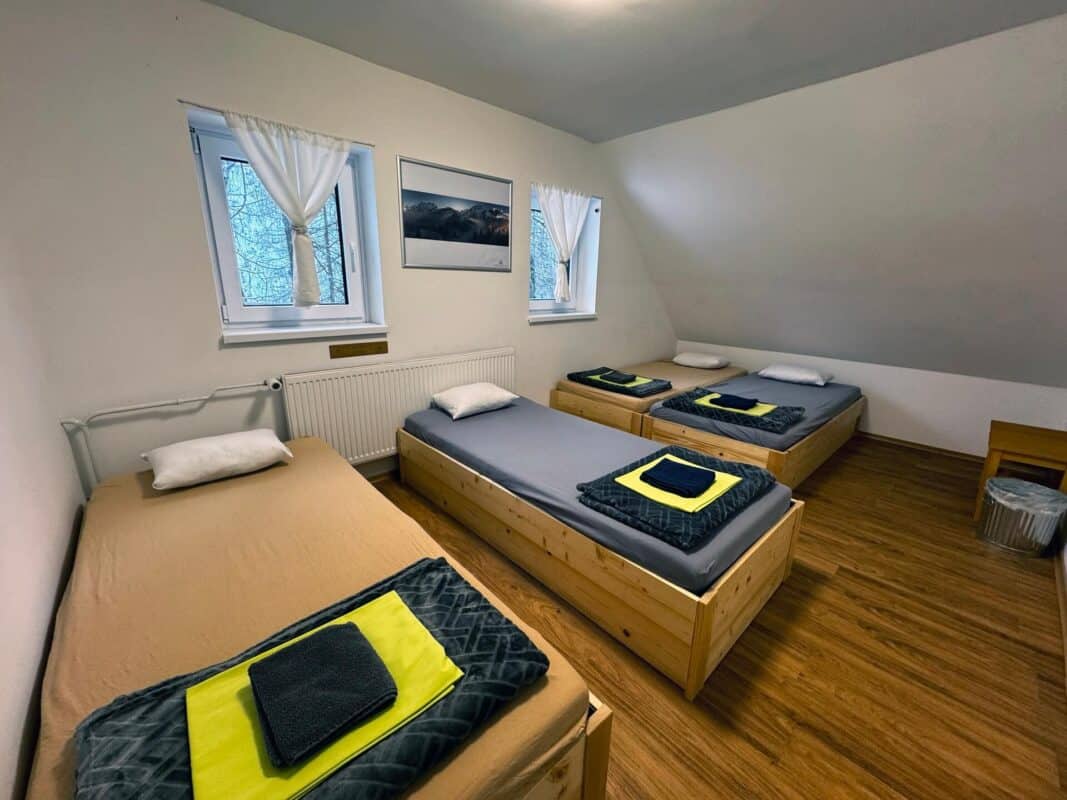
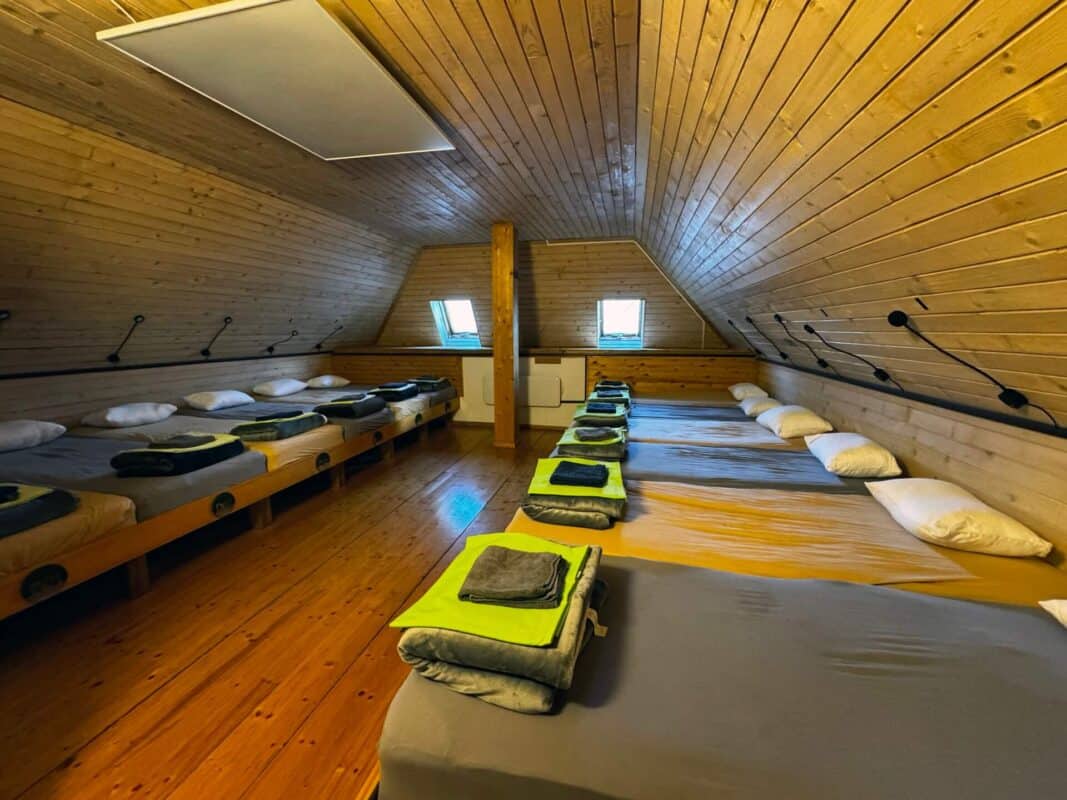
If you plan to stay overnight, check room availability in advance. This is especially important during the hiking season, weekends and good-weather periods.
Food, opening hours and groups
Opening times may vary outside the main summer season or by arrangement with groups. Contact the hut directly for the latest information before making fixed plans.
Self-service planning for your stay at Vršič Pass
- Check room and availability options first.
- Read access, parking and arrival notes before travelling.
- Arrive with your own plan for Vršič, Kranjska Gora, Trenta and the Soča Valley.
- Use contact only for special cases, not for information already explained on the page.
A trusted mountain hut at Vršič Pass
Erjavčeva koča has been part of the Vršič mountain pass experience for generations. Guests use it as a practical alpine base for hiking, cycling, scenic drives, visits to Kranjska Gora and trips toward Trenta and the Soča Valley.
Ready to stay on Vršič Pass? Check the verified accommodation page and reserve directly with the hut.
Erjavčeva koča is a mountain hut at 1525 m, not a hotel or hostel. Come for nature, simple shelter and the rhythm of the mountains.
- ✓Simple mountain-hut comfort and shared house rules
- ✓Direct access to Vršič, trails and Triglav National Park
- ✓Quiet evenings, early starts and weather-dependent mountain life
- ✓Food, shelter and practical help from the hut team
- ×Unlimited parking or guaranteed road access in every weather
- ×Perfect silence during busy mountain days
- ×A valley resort experience
- ×Luxury hotel rooms or city-hotel services
Before you book your stay at Vršič Pass
Use the booking information on this page to decide independently. Booking platforms can help with comparison, but your reservation should be clear before you travel. Contact is only for special cases.
Direct booking is best for
- Checking rooms and availability
- Reading access, parking and arrival details
- Booking when your dates and plan are clear
- Special questions only for groups, late arrival or winter conditions
Booking platforms are useful for
- Comparing accommodation options
- Reading platform-specific reviews
- Managing platform bookings in one account
- Using platform filters and policies
No price guarantee is implied. This block encourages self-service planning and reduces unnecessary calls or emails.
What happens after you check availability?
Checking availability is the first booking step, not a request for personal travel planning. Read the arrival, access and parking information before you book. Contact is only for special cases.
- Choose the room or stay option that fits your plan.
- Complete the booking request with your travel date and arrival plan.
- Before travelling, read the access, parking and seasonal notes; use contact only for groups, late arrival or winter conditions.
CTA clicks are measured as intent signals. This block is designed for self-service reservations and to reduce unnecessary calls or emails.
Summer visit: parking, hiking and rooms
In summer, Vrsic is busy with hikers, cyclists and scenic-road visitors. Plan arrival time, parking, weather protection and overnight questions before you leave.
- Arrive early when parking demand is high.
- Check weather before longer hikes.
- For overnight stays, contact the hut directly before travel.
This block is a practical planning reminder, not a live availability statement.
This guide is prepared from the perspective of Erjavčeva koča, a mountain hut on Vršič Pass. Use it together with current weather, road conditions and responsible behaviour in Triglav National Park.
Triglav Lakes Valley – Triglav National Park
Triglav Lakes Valley - Triglav National Park
100 years since the Triglav Lakes Valley was first insured: a natural beauty that moves time and time again
1 July marks the 100th anniversary of the signing of the Treaty of the Protection of the Triglav Lakes Valley. This gave us the first protected nature park in Slovenia, which is also the precursor of today’s Triglav National Park.
Triglav Lakes Valley - Triglav National Park
When the idea of national parks began to emerge in Europe at the beginning of the last century, it was also considered here. It could very well be that we could have the first national park in Europe in Slovenia. But it was still almost a quarter of a century ago, 100. The Triglav Lakes Valley Protected Area is protected for the first time.
First visitors to the Triglav Lakes Valley
The first records related to the Triglav Lakes Valley date back to the second half of the 18th century. were written by the French naturalist Balthasar Hacquet. Hacquet worked as a doctor in a mercury mine in Idrija, and also did a lot of exploring in Slovenia. He described his encounter with the valley, which he had climbed to over the Komarča, in an emotional way in Oryctographia Carniolica (1778-1789), the first “physical geography” of Carniola:“After 6 hours of walking, at the height of the Alpine range, I came to a bare rocky valley, the like of which I had never seen in my life. Then I wished I had a poet with me who could describe the early days of the upheaval of the world in the most sombre way, as Klopstock did in his epic Messiah.” Of the valley he had walked in its entirety, he wrote that it was“six hours’ walk, winding from noon to midnight, and is called SA LAKE“.

The Triglav Lakes Valley. Photo by Luka Zebec
In the following years, many naturalists visited the valley. Baron Karl Zois, brother of Žige Zois, had a hut built in the valley for exploration. In 1795, the then parish priest and poet of Koprivnica visited the village as part of an exploratory expedition. Valentin Vodnik. The expedition, organised by Žiga Zois, aimed to collect evidence on the origin of the rocks. Grof Franz Hohenwart, co-founder of the Kranj Regional Museum, also a member of the expedition, wrote on seeing the Double Lake that “… inall the mountains of Carniola one cannot find such a beautiful and enchanting view”.
As a result of his impressions of the expedition, Vodnik is said to have written the poem Vršac. Vodnik’s Vršac, a 2194-metre-high lookout mountain in the north of the valley, is also named after Vodnik.

Valentin Vodnik: Vršac
In the second half of the 19th century. century, the Triglav Lakes Valley, or the Valley of the Triglav Lakes. The Zajezer Valley, as it was then called, also began to be visited by ‘tourists’, as the mountaineers were called at the time. During this period, mountaineering associations also emerged, and mountain outposts began to be built. A mountain hut was built at the Double Lake. A mountain trail across the Komarča Mountain and a marked trail through the valley and on to Triglav were created.
First ideas on insurance – Triglav Lakes Valley – Triglav National Park
In 1903, the then Austrian authorities issued an order to collect data on natural monuments. The Gorenjska District Governor’s Office engaged seismologist and natural scientist Albin Belar for this purpose. Belar’s proposal also included the Triglav Lakes Valley: “… The area is geotectonically remarkable, but no less so geologically and palaeontologically … But it is well known to landscape painters, who can see the magnificent motifs at every turn in this wild nature park… It should certainly be recommended that a protected area be established at the Seven Lakes, where all encroachment will be excluded, in order to save the last remnants of this exceptional high mountain primeval forest, the habitat of the ancient larch trees, for posterity…” In 1908, an attempt was made to protect the area, but this was complicated by conflicts with grazing communities and a lack of legal basis. Further attempts were prevented by the First World War.

A depiction of the Triglav Lakes Valley in Balatazar Hacquet’s Oryctographia Carniolica. Photo: DLib
The Seven Lakes Valley Conservation Park
Triglav Lakes Valley – Triglav National Park
After the end of the war and the establishment of the Kingdom of SHS, in 1920, on the initiative of the naturalist Ferdinand Seidl, the Nature Conservation Section of the Museum Society of Slovenia created a Memorial with an initiative to establish conservation parks. It also included a proposal to create a park in the “Valley of the Seven Lakes under Triglav” in the area proposed by Belar. Due to inadequate legislation and lengthy formal procedures, the establishment did not take place for several years.

Extract from the Memorial with an initiative for the establishment of conservation parks (1920).
In 1924 it finally became a protected area. In April, the necessary approvals were obtained from the authorities in Belgrade for the establishment of the conservation park. 1. On July 1924, a lease agreement was signed by the Directorate for the Protection of the Sumatran Mountains, the Museum Society of Slovenia, the Department for Nature Conservation and the Slovenian Mountaineering Society. The treaty defined the scope of t. i. nature conservation park, income compensation for grazing, definition of hunting and exploitation rights and nature protection commitments. The lease period was set at 20 years and the area was 1400 hectares.


Copy of the lease agreement establishing the conservation park. Planinski vestnik, vol. LXXXIV, issue 8, 1984
A detailed presentation of the park was published a year later in the Geografiska vestnik in a technical article and included the first map of the protected area. Author Mate Hafner writes of the park: “We have fulfilled our cultural duty by creating this Alpine conservation park, because only in this way will it be possible to preserve this beautiful territory, which in its entirety, as well as in all its living and non-living parts, is a true natural monument in all its beauty and interest for our descendants.”


Alpine conservation park in the valley of the seven lakes. By Mate Hafner. Map by Valter Bohinec. Geografski vestnik, vol. 1, issue 1, 1925
In 1926, the Slovenian botanist Franc Jesenko first named the park Triglav National Park in the daily Jutro. In his introduction, he wrote: “All the larger of these smaller countries have carved out ready-made areas of their land as convenient reserves where fauna and flora flourish without any cultural influence – where everything lives and grows as God has given it, untouched, unspoilt, in its natural development and in its natural beauty.” He placed Triglav National Park alongside the world parks of the time and advocated for greater protection, in particular the enforcement of a ban on grazing, which was still enforced at the time despite restrictions.


Triglav National Park. Author. Dnevnik Jutro, vol. 7, issue 122. 1926. (The third page of the article has been cut and pasted together, without affecting the content, due to the format of the newspaper.)
In the autumn of 1940, the Department for Nature Conservation prepared a new proposal for the Triglav National Park, which would also include Komna, the Fužinara Mountains and part of the Bohinj Basin. The Second World War prevented discussion of the proposal, and in the meantime the lease expired in 1944.
Triglav National Park “Valley of the Seven Lakes”
Efforts to restore the park on a larger scale began soon after the Second World War. But it took almost 15 years of discussions and proposals from various institutions until the then Council for Culture and Education of the then People’s Republic of Slovenia appointed a special commission to prepare the relevant legislation and a proposal for an enlarged national park. In 1961, the Republican Assembly adopted a Decree declaring the Valley of the Seven Lakes a national park under the name Triglav National Park. This was only 600 hectares larger than during the 1924-1944 protection period. There was no will to expand the park at that time.

Triglav National Park boundary l. 1961 compared to the Alpine Conservation Park in l. 1924.
Source. Author Angela Piskernik, Sketch by Stane Peterlin. 1926.
Triglav National Park
In the following years, efforts to expand the area continued. After numerous discussions and coordination, it was adopted on 27. The Triglav National Park Act, adopted in May 1981, resulted in a large extension of the protected area, similar to the present one, totalling 84,807 hectares. The largest national park in Yugoslavia was established. This marked the end of efforts that began at the beginning of the 20th century. The first phase of the project was initiated by Belar in the 18th century, continued with the Spomenica (1920) and first put into practice 100 years ago, with the first insurance of the Triglav Lakes valley.
Over the years, Triglav National Park has developed into a modern national park with many international links. In 2004, it was awarded the Council of Europe’s Diploma for Protected Area with Exemplary Management. In 2010, the law was reformed. The Triglav Lakes Valley is one of the first conservation areas in the Triglav National Park, and is the most strictly protected.

Protected area boundaries over time. Source: Triglav National Park
Russian grave in the Triglav Lakes Valley
During the First World War, an event took place in Dolina that is still commemorated by a monument. In 1916, a patrol of the Austro-Hungarian army captured two Russian prisoners of war on one of the mountains, who had escaped during the construction of the road to Bogatin. Prisoners of war at that time worked in very poor conditions. The military commandos ordered the prisoners to be taken to the double lake of Lake Triglav and shot. After the war, on the initiative of the editor-in-chief of the Slovene Nation newspaper, Rast Pustoslemšek, funds were raised for a memorial plaque, which was erected in 1923. Over the decades, the monument has been severely damaged by the ravages of time. In 2015, it was restored by mountain rescuer Marko Matajurc on his own initiative.
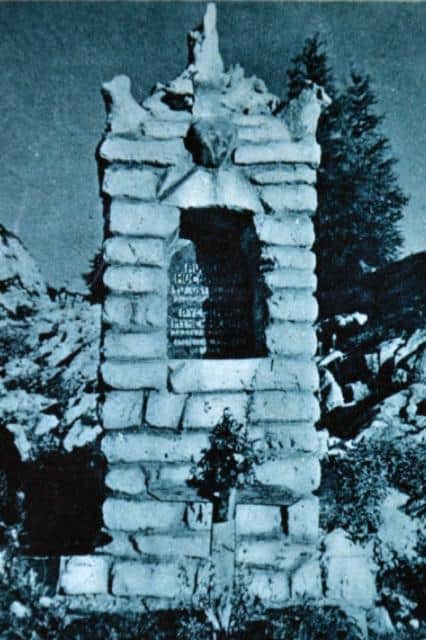
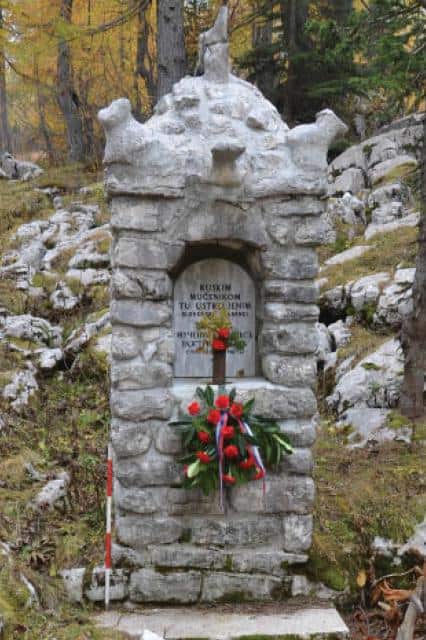
Photo: Illustrirani Slovenec, 1926 / Miha Mihelič, 2018
Literature
Triglav Lakes Valley – Triglav National Park
“History of the efforts to establish the Triglav National Park”. Nature Conservation, Angela Priskernik. 1962.
Planinski vestnik, vol. LXXXIV, issue 8, 1984.
“The founders of Triglav National Park – PEOPLE BEFORE THEIR TIME”, Triglav National Park Public Institute. 2006.
“Valley of the Triglav Lakes”. Geography of Slovenia book collection. 2015.
“The first explorers of the Slovenian mountains and the first documented approaches to them”. Historical newspaper. Peter Mikša. 2013.
“The Russian grave at Triglav Lakes and related events, reflections and feelings”. Monograph CPA 7, Prisoners of War of Tsarist Russia in the First World War on Slovenian Territory. 2018.
“How Triglav National Park was created”, Bulletin of Slovenian field biologists and nature lovers. 2021.
Source: rtvslo.si
Trips and Hikes around the hut
Why visit a moutain hut?
We are open year-round
We are located in the heart of Triglav National Park
Book a stay in the iconic, first-built mountain hut on the Vršič Pass

Erjavčeva mountain hut is open year-round. Reserve your stay and spend some time in the natural paradise of Triglav National Park (UNESCO), near Kranjska Gora, on the Vršič mountain pass in the heart of the park.
Reserve your stayRelated mountain and travel guides
Choose the next verified guide for planning routes, parking, overnight stays and places near Vršič Pass.
- Where can I spend the night? — travel guide
- Triglav National Park Accommodation – Where to Stay in Slovenia’s Alpine Gem — travel guide
- Running spectacle in the Julian Alps — travel guide
- Bohinjsko Jezero — travel guide
- Soteska Vintgar — travel guide
- Slovenia – Julian Alps – Kranjska Gora – Vršič Pass – Erjavčeva koča Mountain Hut — travel guide
Plan your visit from Erjavčeva koča
Useful guides, practical information and accommodation options for Vršič Pass, Triglav National Park and the Julian Alps.
Book your stay at Erjavčeva koča
Ready to stay on Vršič Pass? Check the verified accommodation page and reserve directly with the hut.
Road, parking and arrival FAQ
Use these answers before relying on a route, booking time or parking plan.
Is this a live Vršič road status?
No. The site can guide you to access information, but current road conditions should be checked before departure.
What should I plan before driving up?
Plan the approach, parking, arrival time and a backup option for mountain weather or seasonal traffic.
Can I use the hut as a base for nearby routes?
Yes, but match your route, daylight and return plan before you start.
Where should I go next on the site?
Use the verified access, parking or accommodation links shown on this page.