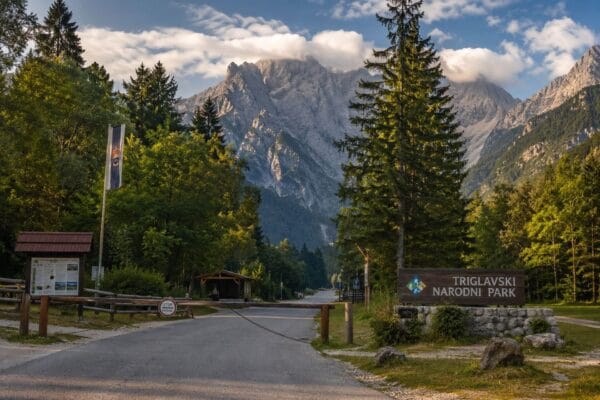
This guide is prepared from the perspective of Erjavčeva koča, a mountain hut on Vršič Pass. Use it together with current weather, road conditions and responsible behaviour in Triglav National Park.
Book your stay at Erjavčeva koča
Ready to stay on Vršič Pass? Check the verified accommodation page and reserve directly with the hut.
Erjavčeva koča is a mountain hut at 1525 m, not a hotel or hostel. Come for nature, simple shelter and the rhythm of the mountains.
✓Expect
✓Quiet evenings, early starts and weather-dependent mountain life
✓Food, shelter and practical help from the hut team
✓Unspoiled nature, mountain views and fresh alpine air
✓A place to rest before or after your mountain trip
×Do not expect
×A valley resort experience
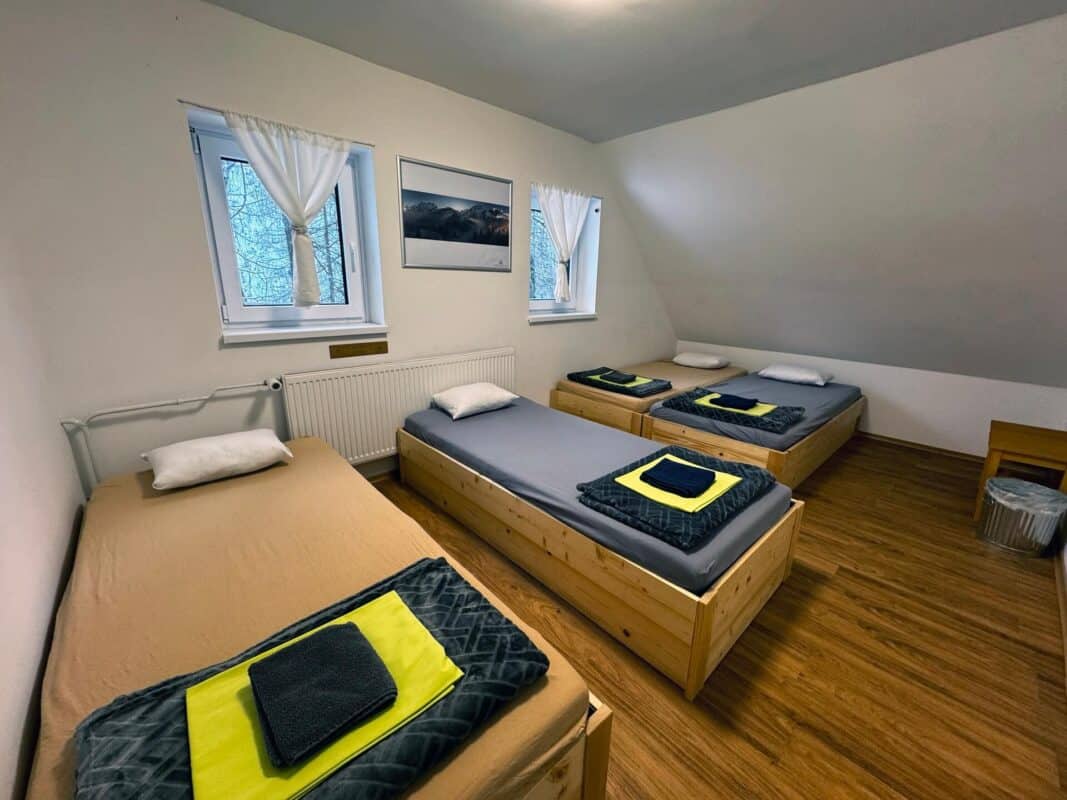
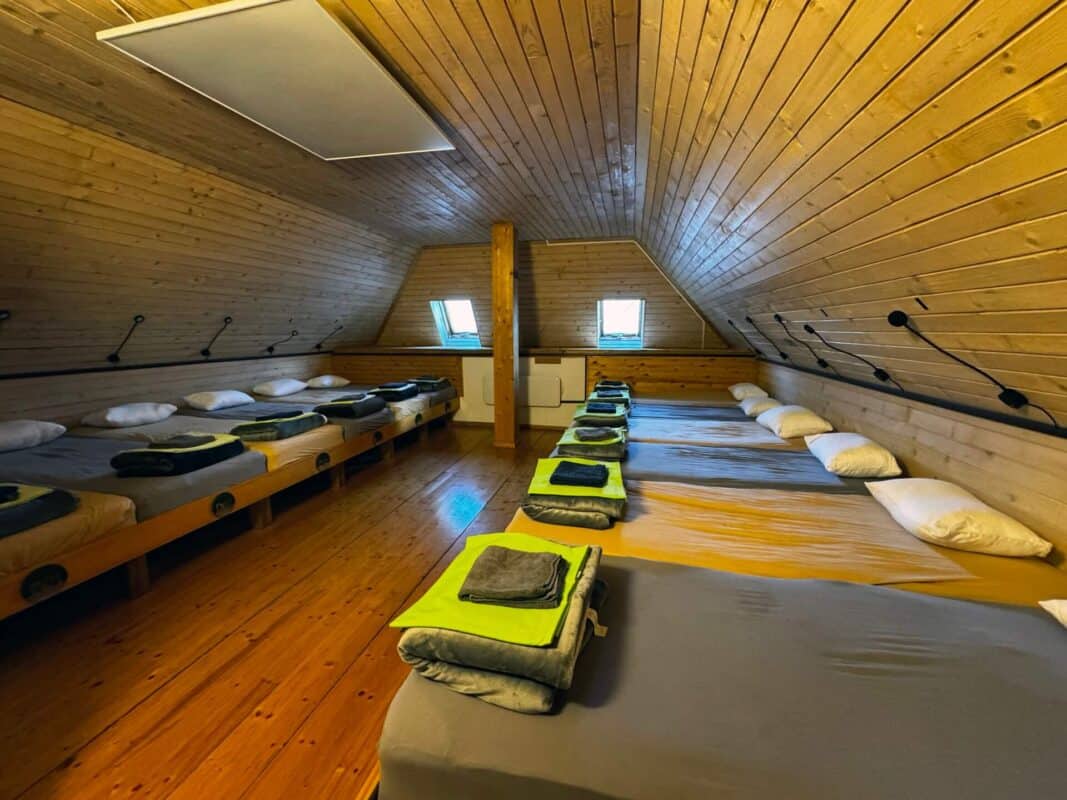
×Luxury hotel rooms or city-hotel services
×Hostel-style nightlife or loud late evenings
×Private bathrooms in every room
Stay on Vršič Pass
Stay at Erjavčeva koča on Vršič Pass
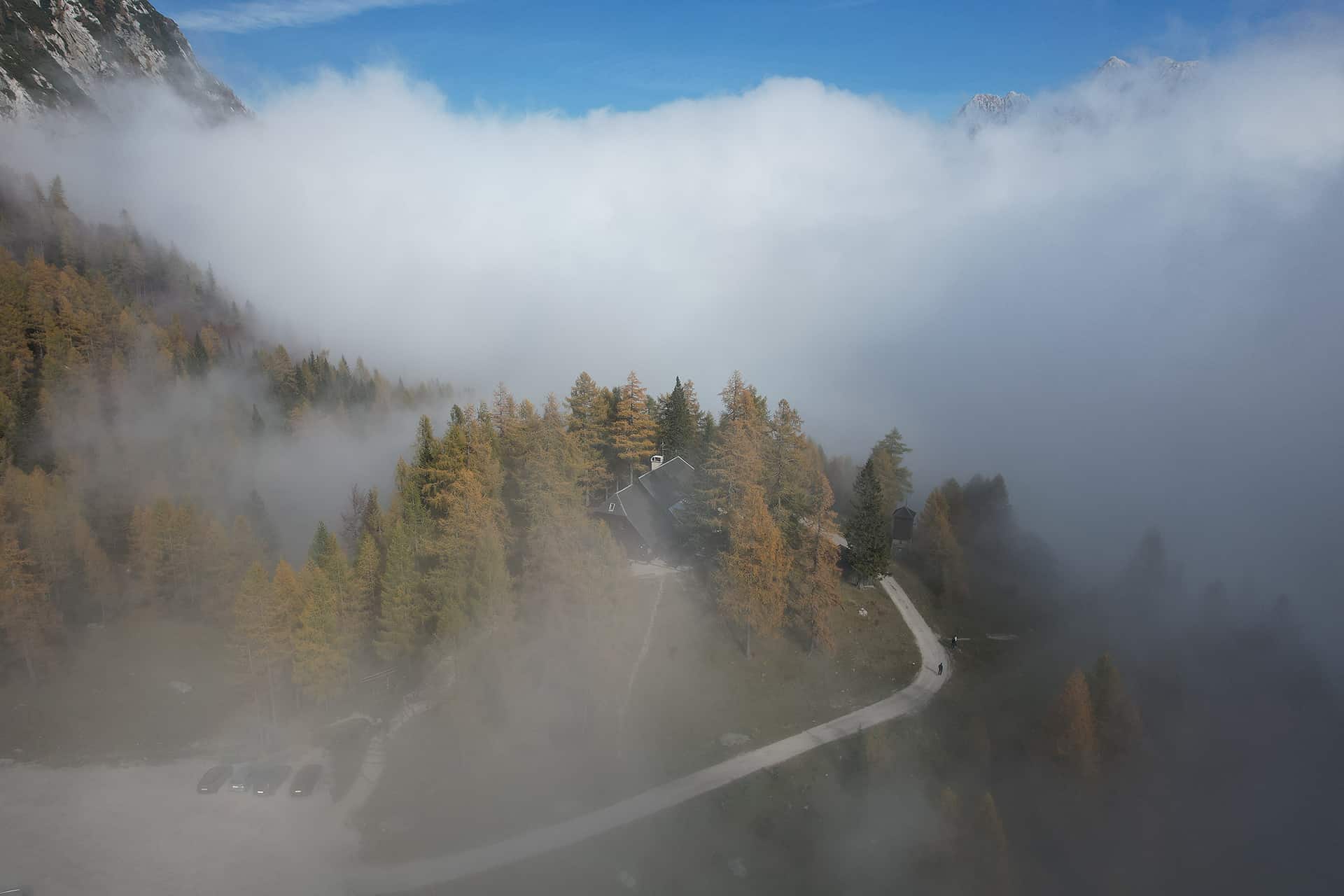
Erjavčeva koča is a mountain hut at Vršič Pass, between Kranjska Gora, Trenta, the Soča Valley and the Julian Alps. It is a practical base for hikers, road-trippers, cyclists and guests who want to stay close to the mountain pass.
Direct location on the Vršič Pass road
Good base for hiking, scenic drives and Julian Alps day trips
Useful for guests visiting Kranjska Gora, Trenta, Soča Valley and Triglav National Park
Food, mountain-hut atmosphere and practical local information in one place
This block is designed for independent guests and self-service booking. It does not imply a price guarantee or live availability.
Before you book your stay
Vršič Pass is a high mountain location, so it is worth checking a few practical details before you travel. This helps you plan your arrival, parking, hiking day and overnight stay more easily.
Access and road conditions
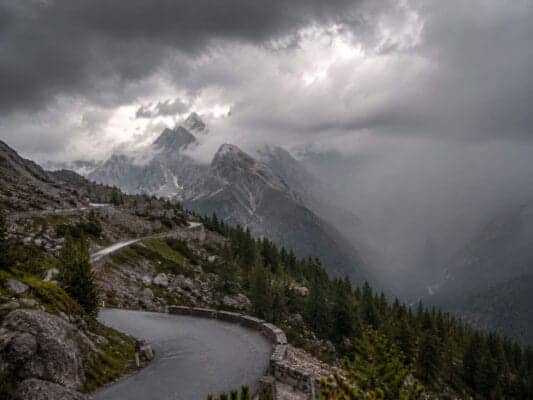
The Vršič road can be affected by season, weather and traffic. Before travelling, check current access information and plan enough time for the mountain road.
Parking
Parking rules and availability around Vršič can change by season and operator. Check the latest parking information before arrival, especially in busy periods.
Rooms and overnight stay
If you plan to stay overnight, check room availability in advance. This is especially important during the hiking season, weekends and good-weather periods.
Food, opening hours and groups
Opening times may vary outside the main summer season or by arrangement with groups. Contact the hut directly for the latest information before making fixed plans.
Self-service planning for your stay at Vršič Pass
Check room and availability options first.
Read access, parking and arrival notes before travelling.
Arrive with your own plan for Vršič, Kranjska Gora, Trenta and the Soča Valley.
Use contact only for special cases, not for information already explained on the page.
A trusted mountain hut at Vršič Pass
Erjavčeva koča has been part of the Vršič mountain pass experience for generations. Guests use it as a practical alpine base for hiking, cycling, scenic drives, visits to Kranjska Gora and trips toward Trenta and the Soča Valley.
Use the booking information on this page to decide independently. Booking platforms can help with comparison, but your reservation should be clear before you travel. Contact is only for special cases.
Direct booking is best for
Checking rooms and availability
Reading access, parking and arrival details
Booking when your dates and plan are clear
Special questions only for groups, late arrival or winter conditions
No price guarantee is implied. This block encourages self-service planning and reduces unnecessary calls or emails.
What happens after you check availability?
Checking availability is the first booking step, not a request for personal travel planning. Read the arrival, access and parking information before you book. Contact is only for special cases.
Choose the room or stay option that fits your plan.
Complete the booking request with your travel date and arrival plan.
Before travelling, read the access, parking and seasonal notes; use contact only for groups, late arrival or winter conditions.
CTA clicks are measured as intent signals. This block is designed for self-service reservations and to reduce unnecessary calls or emails.
Summer visit: parking, hiking and rooms
In summer, Vrsic is busy with hikers, cyclists and scenic-road visitors. Plan arrival time, parking, weather protection and overnight questions before you leave.
Arrive early when parking demand is high.
Check weather before longer hikes.
For overnight stays, contact the hut directly before travel.
This block is a practical planning reminder, not a live availability statement.
Last updated: 09/02/2026First published: 09/01/2026Reading time: 13 min readPrepared by: Erjavčeva koča team
Vrata — Trenta — Vršič (1922)
Vrata — Trenta — Vršič (1922)
Vrata — Trenta — Vršič (1922)
(pages 35–41 / 3-9)
Slovenia has many beautiful hiking destinations, but Vrata is the most beautiful of them all. Seven years ago, the Saxon king was in Vrata and spent the night at Smerc’s. Baedeker compares Vrata to the most beautiful valleys in Europe. These are the gates to mighty Triglav! In Vrata, Janko Mlakar addresses a woodcutter: “Father, Triglav is great!” The man replies: “Great it is, great—but how much of it is still in the ground!”
Vrata — Trenta — Vršič (1922)
Vrata — Trenta — Vršič
I was in Vrata for the first time in 1883, in the company of the chaplain (later dean) Novak, the teacher Rozman, a student (later parish priest) V. Jakelj, and a few others. At that time, I was a parish priest at Dobrava near Kropa. Parish priest Janez Ažman of Dovje had understanding and good taste for natural beauty; he praised Vrata to us, though he himself had to stay home because of a sick parishioner.
So we went to Vrata with the intention of returning the same evening. But how we changed our minds when we entered the valley—past Peričnik, along the lively Bistrica, among mountain giants, with ever new scenes, magical rock formations, steep walls, snow on the Triglav face and even at its base—truly the Kingdom of Zlatorog! At that time, there was no route from Vrata to Triglav. People came only from Bohinj or via Krma to the Maria Theresa Hut. But we were tempted, and I urged, “Let’s go up here (over the Prag).”
Of course, we would not have made it, because at that time there were no iron pegs across the Prag. Later, in 1890, old Smerc’s father told me that once, as a hunter, he had climbed over the Prag when there were still no pegs. “What is it like?” I asked him. “Ugly, ugly,” he replied. Long ago, an old bear wanted to descend from above over the Prag into Vrata and roared terribly because he could not get down that way. I was told that in 1880, the last bear in Vrata was shot.
Later hunters installed pegs across the Prag, of course, for themselves, not for tourists. Požganc and Kobar, workers on Triglav, also set pegs into the rock here. Both were bold climbers. Once they descended from Triglav carrying their tools. The hunter Rabič warned them: “Go around Cmír into Vrata and start driving pegs into the Prag from below.” But Požganc, who feared no rock, replied: “Why go around and lose a whole day—we’ll just crawl down over the Prag.” Požganc took off his boots, indeed climbed down over the Prag, and called to Kobar to lower the hammer and other tools on a rope: “You don’t even need to take off your boots.” Požganc and Kobar reached Triglav by several routes when there was still no path—for example, over Zeleni sneg to the Saddle, from Kredarica over Mali Triglav, and from Šmarjetna Glava upward, where today Kugy’s route runs. Near the summit, Kobar said to Požganc: “Oh, I can’t turn around.” “You will,” came the reply—and they went on with the tools on their backs.
My party in Vrata in 1883 rested a little at the source of the Bistrica, at the foot of Triglav, whose sheer northern wall is famed throughout the mountaineering world. Novak had quite a bit of flour with us; the students only a little. “Shall we go to Luknja?” Everyone shouted: “Let’s go—then either home or on to Trenta, even without a guide. Courage counts!” Jakelj and I went straight toward the Triglav wall because we wanted to stay close to it all the way to Luknja; the others went faster, lower down in the gully. Rozman carried my juniper brandy (a large bottle); they drank it eagerly and called out, “To your health! Živio!” Then they placed the empty bottle on a rock. We decided on revenge. I said: “Let’s go behind that rock onto the snowfield and pretend to throw snowballs, meanwhile drinking as much wine as we can from my small cask, then stuffing snow into it. By the time we reach Luknja, it will have melted—it’s still two hours away.” They called: “Where are you, what are you doing?” We threw snowballs—and in between drank wine and packed snow and ice into the cask.
Vrata — Trenta — Vršič (1922)
Vrata — Trenta — Vršič
The direct route along the Triglav side was hard—sometimes two steps up in the scree and three steps back. When I reached the path, I kissed it and cried out, “Servus, Triglav!”—Jakelj did the same. Our route along the wall through steep scree was strenuous.
After much effort, my party scrambled up the rocks, where there was then no path—nor any red markings—to the top of Luknja. We sat down: now we would eat and drink. A magnificent scene—on the right Triglav, on the left Pihavec; before us Vrata, behind us Trenta. Here is the border between Carniola and Gorizia. Even chamois respect the border at Luknja. Why? A hunter told me: ” When I want to get a chamois quickly, I drive it toward Luknja; up there the chamois turns back, knowing: ‘When I stick my head through Luknja, a Trentar will shoot me.” It turns back—and then I shoot it.
When we finished eating, Novak said, “Now we’ll drink. First, let’s open Aljaž’s cask.” But behold—the wine in the glass was so cloudy, with a thick sludge at the bottom! He tasted and tasted: “What is this?” I said, “From carrying, the wine got muddy.” Novak replied: “You scoundrels—you drank the wine and stuffed snow into it!” Everyone laughed and threatened us. We said: “Wine for juniper brandy, tooth for tooth.”
Sheep and goats grazed on Pihavec. Novak said, “I’d like to drink milk; let’s call the goats down.” “That’s a sin,” we said. “What sin? A glass of milk—I’ll gladly pay the shepherd.” We began calling: “Soli, soli,” and soon one came down. Novak joyfully approached it with a glass, then immediately returned, saying: “It’s a billy goat!” We burst out laughing.
“Let’s go to Trenta; there we’ll drink Italian wines.” “But we don’t know the way,” the others said. We considered whether to follow Triglav or Pihavec, as the middle section features a deep ravine and steep slopes on both sides. We decided to go along the Triglav wall. Soon, we came to a steep scree chute with a great abyss below. The students flew down quickly, stones rattling thunderously into the ravine. Novak descended slowly from above, but the sand carried him downward. “Help!” he cried. With difficulty, we got him across.
Vrata — Trenta — Vršič (1922)
Vrata — Trenta — Vršič
We went downward, increasingly worried whether we could descend into Trenta here. From Triglav flows the stream Zadnjica. The other (right) side, along Pihavec, seemed better, but we could not reach it because of the deep ravine. Fortunately, we spotted a Trentar on the other side. “Hey! Is this the right way to Trenta?” we shouted. Instead of answering, the Trentar descended a steep wall into the ravine, disappeared for a while, then poked his head over the wall on our side and said: “Right—right!” He came kindly to us, and we gave him a gift. The Trentar people are good but very poor; if you meet one, he readily accepts alms. He has little more than a bit of potatoes in some small hollow; they mow grass on rocks for their sheep, yet they deeply love their home and their mountains. When Emperor Joseph II settled some of them in Hungary, they all returned to Trenta.
The late Miha Ambrožič, a beekeeper in Mojstrana, later told me that he, too, used to go over Luknja to Trenta for bees, but on the Pihavec side, and he explained what kind of “telegraph” the Trentar has after I showed him mine. When I came to Trenta for bees, the master of the house was not home. “Wait a bit,” said the wife, “he’ll be back soon.” She took a white sheet and spread it on the ground in front of the house. The Trentar looked down from the mountain several times, and when he saw the sheet, he hurried home.
Quite exhausted, we reached the Trenta valley, where the Zadnjica flows into the Soča. At that time, there was no hut there to refresh ourselves; we had nothing left to eat or drink. We thought we would reach an inn, but in the whole of Trenta there was none. What to do? Novak and I agreed to ask the Trenta parish priest to take our party in for pay. The young Trenta priest, Simon Gregorčič, a distant relative (fourth degree) of the poet Simon Gregorčič, received us gladly, and his diligent sister willingly brought us bread and wine and prepared supper. Before supper, S. Gregorčič took us to the interesting spring of the Soča in a cavern. An excellent mountaineer, he told us many stories from his life. A week earlier, Field Marshal Kuhn had gone from Kranjska Gora over Vršič to Trenta with the general staff and spent the night at the rectory. In the afternoon, Razor is beautifully visible from Trenta in the sunlight; Kuhn ordered his adjutant to draw Mount Razor. In the rectory, Kuhn examined Gregorčič’s large library and said, “It seems you are a Pan-Slavist!” “Indeed, I am,” he admitted. Kuhn took no offence, for Gregorčič was witty, harmless, and treated them well.
Vrata — Trenta — Vršič (1922)
Vrata — Trenta — Vršič (1922)
In the morning, Kuhn thanked the priest and said, “Now take another hat and come with us to the Soča.” “This one is good enough; I’ll go with you.” Such a hat was once worn by Janko Mlakar in the mountains; in recent years, he lost it and now—so they say—goes bareheaded.
I must not forget to mention the Trenta sexton Špik, whose beard was torn off by a bear. German tourists mention him in their newspapers because he likes to show himself to them in Trenta. He shot a bear above Stenar, and the bear fell; when he approached it, the bear struck him with its paw, knocking out his entire lower jaw. Now he wears a scarf over his mouth and neck; when he eats, he lies on his back and pours liquid food down his throat. When the Emperor passed through Predel on his way to Gorizia in 1882, the district head introduced Špik to him. The Emperor asked who had treated him. He replied: “No one but the parish priest.” Years later, Špik was killed by a larch tree he had cut on Christmas Eve.
The Trenta valley is three hours long; at that time, it had no carriage road at all, not even to the Soča. The archbishop came on horseback for confirmations. Since confirmations were rare and young people in Trenta had never seen a horse, a boy ran home shouting: “Oh, mother, you won’t believe what a huge goat the bishop was riding!” Gregorčič was in Trenta “everything in one”—pastor, municipal secretary, teacher, postman—as were his successors.
Very tired, we went to sleep at the rectory. In the morning, Novak celebrated Mass in the friendly church, and I served him, half asleep. I nodded off repeatedly while standing, then woke again; finally, I knelt. The others noticed and later teased me on our way to Kranjska Gora. Gregorčič accompanied us, intending to dash up Mojstrovka on the way, later saying he would go with us to Kranjska Gora for a mug of beer! He climbed Mojstrovka in winter—and indeed went alone in midwinter! A daring man! What happened? On the steep icy face, he slipped—hurtling toward the southern abyss—but luckily caught himself with one foot on a narrow stone and hung there, unable to go forward or back. When he did not return by evening, his sister alerted neighbours; the Trentar people went up with torches and ropes, heard his voice, lowered a rope, and pulled him up. When the archbishop learned of this, he transferred him elsewhere.
The Trentar people are true heroes on the rock. When Dr. Stoje had an accident on Škrlatica and lay alive awaiting rescue, Carniolan guides deliberated carefully how to reach him; the Trentar people immediately climbed to him, seized him, and safely brought him down. A Trentar who shot a chamois beneath the north wall of Mojstrovka was ambushed by Kranjska Gora hunters and gendarmes—“now we’ve got him.” But the Trentar escaped straight up a vertical wall and vanished halfway up the face. They watched in vain.
After the war, I wished to visit Gregorčič again—but learned he had died. Above Plava in the mountains, he had heard confessions of dying soldiers poisoned by gas bombs; he himself was poisoned in the process and died. He was an ideal priest, a gentle soul.
Ten years later, I walked the same route—Vrata, Luknja, Trenta—in the company of Mr. Sušnik and Dr. Svetina. This time, we continued from Luknja on the proper path to the right, beneath Pihavec. Suddenly, stones began to fly at us—some whizzing through the air, others bouncing from the steep wall—terrifying. Sušnik ran quickly ahead along the slope; the two of us pressed ourselves to the ground. Who had dislodged the stones? Some malicious person? The old guide Klančnik said: “It was the sheep grazing above Pihavec.” We also went to the source of the Soča—three of us into the cavern with the small lake; Klančnik stayed outside. Suddenly, stones began flying at Klančnik, and a piece of larch wood struck his back with such force that it crushed the tinware in his pack. Klančnik shouted loudly. We waited in the cavern, then cautiously came out, looked upward, and saw a billy goat above that had nearly caused a disaster. Such are the mountains!
Vrata — Trenta — Vršič
Vrata — Trenta — Vršič (1922)
At that time, there was no hut on Vršič. The Germans selected—but did not buy—a safe spot on the saddle on a knoll along the path toward Mojstrovka. That place was also offered to me in secret when Roblek and I went up to look for a site. But I chose a better, also safe, place near a spring, where the Germans later built Voss’s hut. Someone betrayed me, and the Germans beat me to it. The Slovenes later built (especially through the efforts of Dr Tičar) a hut on the Gorizia side of Vršič, in a beautiful location, though not as safe from avalanches. Because the Germans took the site of Voss’s hut from me, I took revenge and quickly wrote to Dr Tominšek to buy land by the Kriška Lakes (behind Stenar), where the Germans had planned to build a hut. Unfortunately, both places now lie in occupied territory.
We are located in the heart of Triglav National Park
Book a stay in the iconic, first-built mountain hut on the Vršič Pass
Erjavčeva mountain hut is open year-round. Reserve your stay and spend some time in the natural paradise of Triglav National Park (UNESCO), near Kranjska Gora, on the Vršič mountain pass in the heart of the park.
We use cookies to improve your browsing experience, measure traffic, and enhance website functionality. You can accept all cookies, reject non-essential cookies, or manage your preferences. Cookie Policy,
Privacy Policy
and Terms of Use.
!
Google Maps displays incorrect information that the road to Erjavčeva koča is closed. The road to Erjavčeva koča is open and normally passable from both directions.



 Slovenščina
 Bosanski
 Hrvatski
 Čeština
 Dansk
Dansk Dutch
Dutch Suomi
Suomi Français
 Deutsch
 Magyar
 Italiano
 Polski
 српски
 Slovenčina
 Español
 Svenska