This guide is prepared from the perspective of Erjavčeva koča, a mountain hut on Vršič Pass. Use it together with current weather, road conditions and responsible behaviour in Triglav National Park.
Book your stay at Erjavčeva koča
Ready to stay on Vršič Pass? Check the verified accommodation page and reserve directly with the hut.
Erjavčeva koča is a mountain hut at 1525 m, not a hotel or hostel. Come for nature, simple shelter and the rhythm of the mountains.
✓Expect
✓Direct access to Vršič, trails and Triglav National Park
✓Quiet evenings, early starts and weather-dependent mountain life
✓Food, shelter and practical help from the hut team
✓Unspoiled nature, mountain views and fresh alpine air
×Do not expect
×Perfect silence during busy mountain days
×A valley resort experience
×Luxury hotel rooms or city-hotel services
×Hostel-style nightlife or loud late evenings
Stay on Vršič Pass
Stay at Erjavčeva koča on Vršič Pass
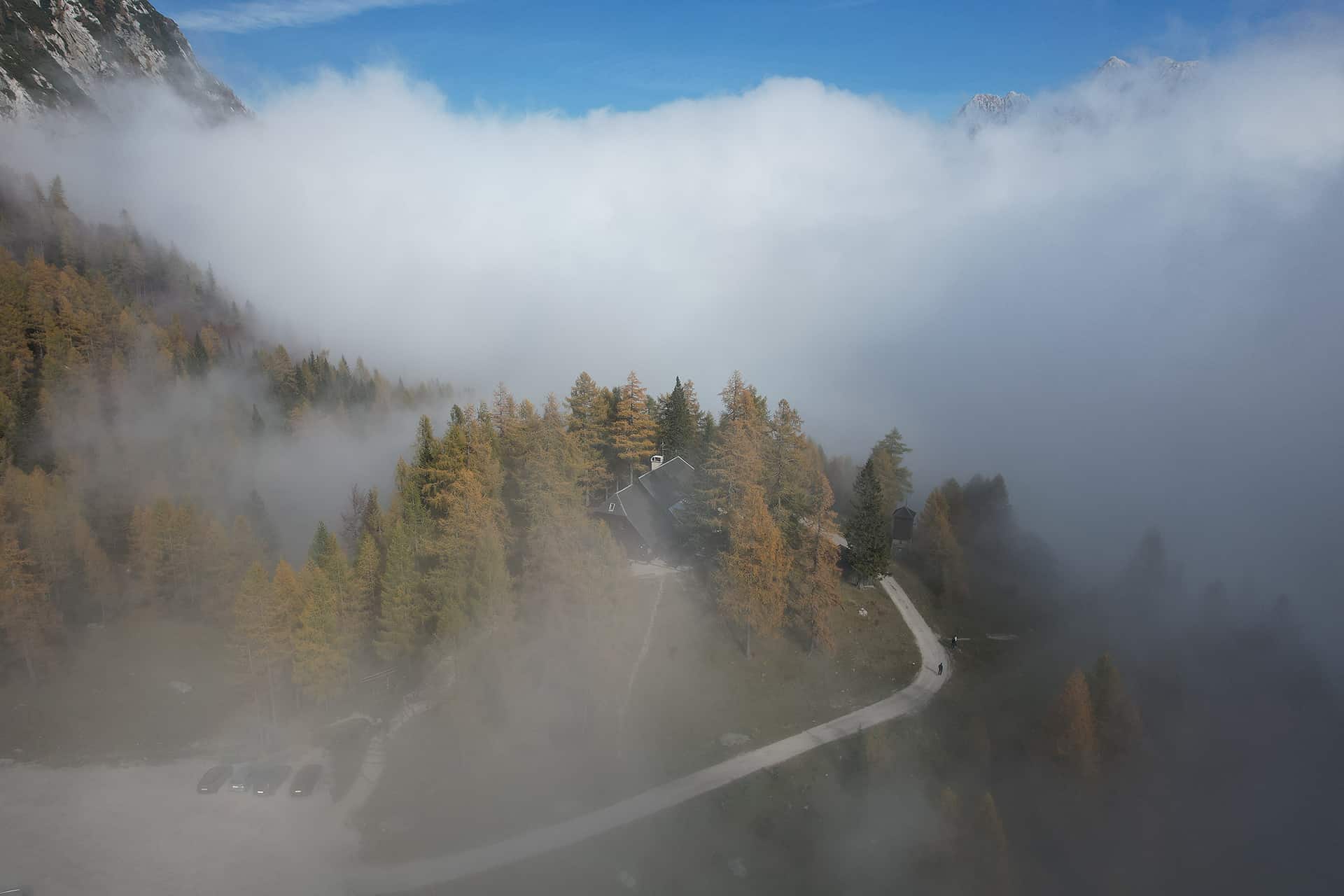
Erjavčeva koča is a mountain hut at Vršič Pass, between Kranjska Gora, Trenta, the Soča Valley and the Julian Alps. It is a practical base for hikers, road-trippers, cyclists and guests who want to stay close to the mountain pass.
Direct location on the Vršič Pass road
Good base for hiking, scenic drives and Julian Alps day trips
Useful for guests visiting Kranjska Gora, Trenta, Soča Valley and Triglav National Park
Food, mountain-hut atmosphere and practical local information in one place
This block is designed for independent guests and self-service booking. It does not imply a price guarantee or live availability.
Before you book your stay
Vršič Pass is a high mountain location, so it is worth checking a few practical details before you travel. This helps you plan your arrival, parking, hiking day and overnight stay more easily.
Access and road conditions
The Vršič road can be affected by season, weather and traffic. Before travelling, check current access information and plan enough time for the mountain road.
Parking
Parking rules and availability around Vršič can change by season and operator. Check the latest parking information before arrival, especially in busy periods.
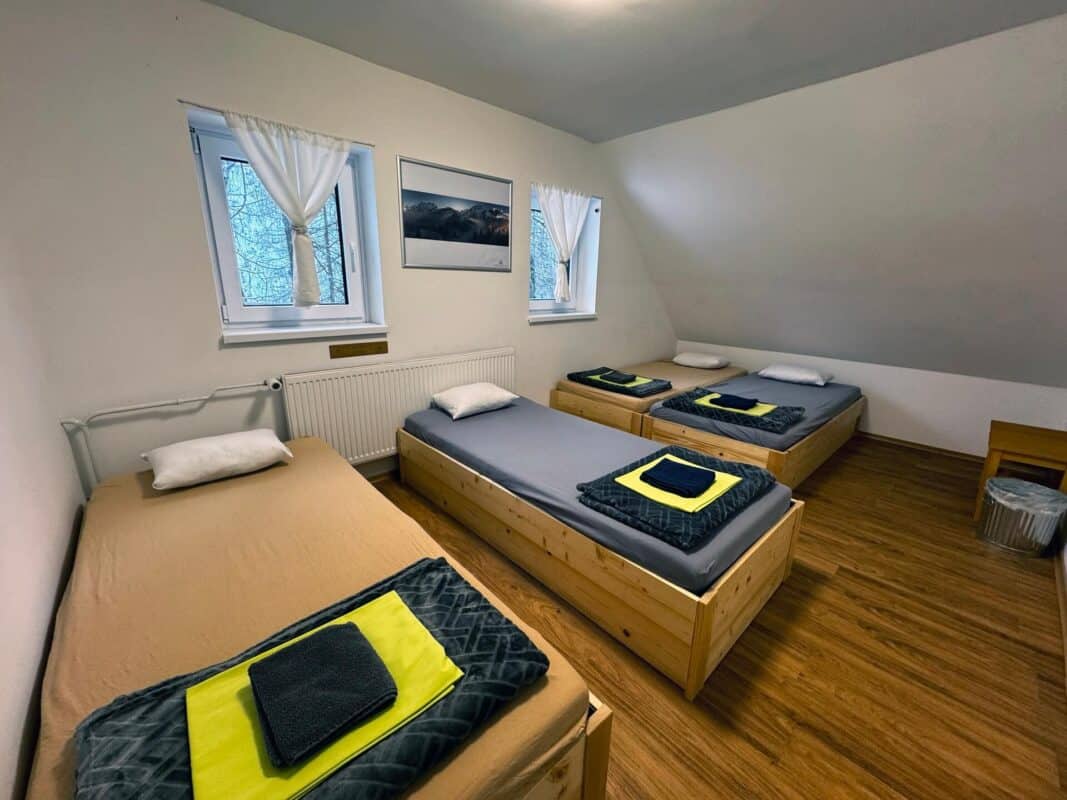
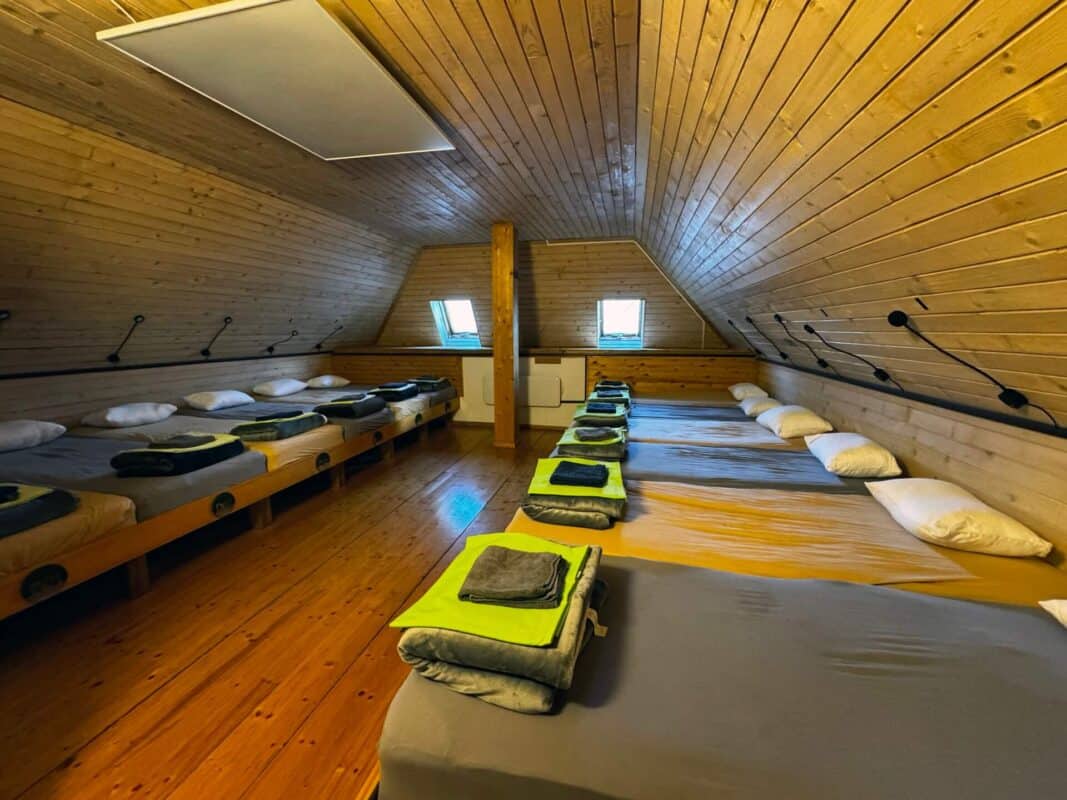
Rooms and overnight stay
If you plan to stay overnight, check room availability in advance. This is especially important during the hiking season, weekends and good-weather periods.
Food, opening hours and groups
Opening times may vary outside the main summer season or by arrangement with groups. Contact the hut directly for the latest information before making fixed plans.
Self-service planning for your stay at Vršič Pass
Check room and availability options first.
Read access, parking and arrival notes before travelling.
Arrive with your own plan for Vršič, Kranjska Gora, Trenta and the Soča Valley.
Use contact only for special cases, not for information already explained on the page.
A trusted mountain hut at Vršič Pass
Erjavčeva koča has been part of the Vršič mountain pass experience for generations. Guests use it as a practical alpine base for hiking, cycling, scenic drives, visits to Kranjska Gora and trips toward Trenta and the Soča Valley.
Use the booking information on this page to decide independently. Booking platforms can help with comparison, but your reservation should be clear before you travel. Contact is only for special cases.
Direct booking is best for
Checking rooms and availability
Reading access, parking and arrival details
Booking when your dates and plan are clear
Special questions only for groups, late arrival or winter conditions
No price guarantee is implied. This block encourages self-service planning and reduces unnecessary calls or emails.
What happens after you check availability?
Checking availability is the first booking step, not a request for personal travel planning. Read the arrival, access and parking information before you book. Contact is only for special cases.
Choose the room or stay option that fits your plan.
Complete the booking request with your travel date and arrival plan.
Before travelling, read the access, parking and seasonal notes; use contact only for groups, late arrival or winter conditions.
CTA clicks are measured as intent signals. This block is designed for self-service reservations and to reduce unnecessary calls or emails.
Summer visit: parking, hiking and rooms
In summer, Vrsic is busy with hikers, cyclists and scenic-road visitors. Plan arrival time, parking, weather protection and overnight questions before you leave.
Arrive early when parking demand is high.
Check weather before longer hikes.
For overnight stays, contact the hut directly before travel.
This block is a practical planning reminder, not a live availability statement.
Last updated: 09/02/2026First published: 08/01/2026Reading time: 17 min readPrepared by: Erjavčeva koča team
Climbing Routes in the Eastern Julian Alps (1924)
Climbing Routes in the Eastern Julian Alps (1924)
Climbing Routes in the Eastern Julian Alps
Dr. Klement Jug
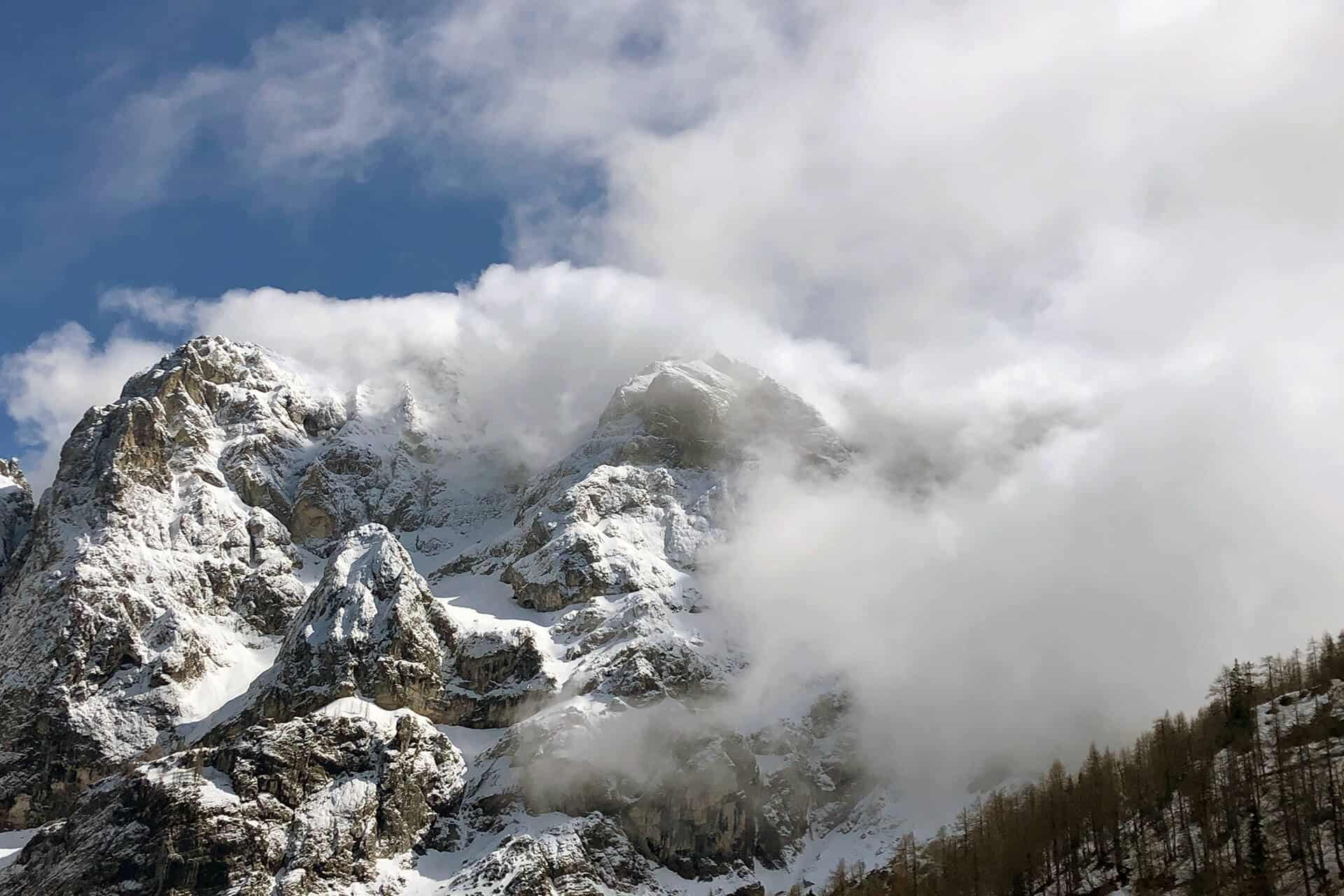
Beautiful and proud, the north-western face of Prisojnik rose on the morning of 20 August 1928 at dawn toward the clear sky, threatened only by a few clouds, which suggested that north and south were still fighting for final victory. At half past four, we set out from Erjavčeva Hut with Kajzelj, determined to make an attempt on this face. Through dwarf pine and forest, we struck into the gully of a violent torrent and followed it down into Suha Pišnica beneath the wall. We had already heard much—good and bad—about this face; therefore, when we looked at it, we were filled with a mysterious anticipation: “Will it work?” The wall remained silent, as if it were keeping its own counsel. “It must!”—thus, we finally put an end to our deliberation.
Climbing Routes in the Eastern Julian Alps (1924)
Up to that point, we knew very little about the wall itself. We knew that roughly a month and a half earlier the face had been climbed by comrades Dr. Stanko Tominšek, Jože Čop, and Janez Kveder (see Planinski vestnik 1924, p. 4 ff., and the photograph of the Prisojnik face appended to Planinski vestnik 1924, no. 1); but we had not the slightest idea which line the three of them had taken. The general directions given to us by the caretaker of Erjavčeva Hut were so vague that—as soon became apparent—they hindered us more than they helped.
We reached Suha Pišnica directly opposite the lower end of the glacier, or rather the snowfield, which together with the surrounding walls covers the bottom of a long, wide couloir. In the middle of the snowfield, a transverse crevasse forms where a rock step beneath the snow breaks the surface: below this step, the snow detaches in the same way as along the walls, forming a fissure. At the upper end, where smooth walls close the couloir on all sides, a tall waterfall plunges down onto the snowfield from the right.
It seemed most natural to me to enter the wall at this icefield. But we were confused by the caretaker’s explanations, according to which the first ascensionists had climbed via some grassy ledges far to the right of the icefield. So beneath the icefield we turned right and followed a torrent channel, then crossed snowfields and scree along the wall upward, entered a kind of gully, followed it parallel to the wall farther on to a broad grassy ledge, and searched there for an entry into the wall along the entire long ledge almost to the ridge above the Vršič saddle—yet all without success.
At last, it seemed ridiculous to keep asking others where to enter the wall, rather than relying on our own judgment. We therefore decided to return beneath the icefield with the waterfall, inspect the wall there, and make our own plan for the climb, without regard for everything with which others had distracted us so far. At half past six, we were again safely beneath the wall at the icefield. This mistake had therefore cost us a full two hours!
Climbing Routes in the Eastern Julian Alps (1924)
Beneath the icefield, we devised a plan that we were then able to follow all the way to the summit without having to retreat anywhere or search for alternative passages.
A climber who has already climbed many faces gradually acquires a special ability to read walls. A strange intuition tells him where he will be able to climb the wall not only at the bottom but higher up as well, even though he cannot see far upward from within the wall itself or directly beneath it. The entire wall is visible only from afar; from a distance, it is seen not as it truly is, but only in two dimensions—height and width—almost without depth. From afar, it is therefore difficult to discern how the wall is structured and where suitable passages lie. But to the experienced climber, instinct or intuition within the wall itself tells far more: where to climb so that impassable sections will not block him higher up, even if the entry below looks good.
Every wall is, of course, more passable the more gently inclined and the more articulated it is. And usually the wall that is generally more articulated—one with more cracks, grooves, chimneys, and finally gullies—offers more handholds for climbing. Where such features occur higher in the wall, they also affect the lower parts beneath them. Cracks, grooves, chimneys, and gullies expose the wall below to torrents, avalanches, falling stones and rockfall more than other parts of the wall. Lower down, therefore, the wall becomes increasingly broken and, correspondingly, more similar in structure to the higher wall.
A climber may not always consciously understand this relationship between the higher and lower parts of the wall, nor be able to explain why he feels drawn to a certain direction. But many experiences give him the ability, at first glance at the entry, to intuitively sense in which direction the wall will be passable higher up, without detailed reasoning and without seeing the upper wall. Such a self-reliant climber errs less often than one who plans based on others’ descriptions, sketches, and so on, because walls are so complex that the same description can be interpreted differently. A good description only points out the generally passable areas; in all details, one must rely primarily on one’s own abilities. And it is also more genuinely “touristic” to conquer walls by one’s own judgment, free of guides and advice. One is more independent and freer. One can tackle unknown walls and find exits that could never be guessed from a distant view.
Climbing Routes in the Eastern Julian Alps (1924)
In this way, Kajzelj and I always chose the right line. On the Prisojnik face, we essentially followed—later determined to be—the same route as our predecessors, which proves that the wall itself guides the independent climber in the right direction. Where our predecessors went, we went as well, even though we each entered the wall at a different point.
At half past six, we therefore found a suitable entry into the wall. We climbed the snowfield in the couloir beneath the waterfall up to the transverse crevasse, bypassed it, and immediately above it entered the wall via narrow ledges filled with scree that trended to the right, out of the couloir. Walking on the scree was awkward, as it slid beneath our boots toward the void. Along these ledges, we reached grassy terraces overgrown with dwarf pine and larch. Across them we zigzagged, partly forcing our way through the pines, partly climbing upward, then a little downward to the left, then upward again to the left, then retreating slightly downward—only then could we finally climb up to a ledge from which we traversed horizontally left to a point above the waterfall, where in the corner above the couloir the water emerges at the end of the ledge beneath smooth walls.
There we put on our climbing shoes, jumped across the water, and entered the wall, which is fairly smooth but has good holds. We climbed this wall rather quickly, keeping as far to the right as possible so as not to stray too far across from the narrow, steep, smooth couloir that begins in the corner above the water source and widens higher up into a large, steep snowfield. A little below this snowfield, we managed to climb from the smooth wall into the couloir itself. There we put our boots back on and went up the snow.
Here, Kajzelj had bad luck and slipped on the snow. I quickly plunged my ice axe into the snow near him so that he could grab it, but he did not, because in his haste, he tried to stop himself with his own axe. When that failed, he involuntarily slid some ten meters down the snow into the stones of the couloir. He cursed properly, in the Carniolan fashion—but he was fine. After that, he preferred to cut steps in the hard snow rather than walk on the surface as before.
The snowfield we crossed is enclosed on all sides by walls, opening only higher up to the right. From the snow one reaches a tower (“turnec”) in the middle of the Prisojnik face; beneath the tower, beneath dark brown cliffs, a broad, hanging ledge runs for a considerable distance. Directly above the snowfield, left of the tower, is a smooth wall forming a step that separates the upper snowfield behind the tower from the lower one beneath it. I was tempted to climb directly across the wall left of this step, which would have been shorter than going around the tower; but near the top, the wall looked impassable, so I followed Kajzelj, who favoured going around the tower on the right.
Thus, we traversed right along the ledge beneath the tower until we reached a point where the wall above was sufficiently broken for climbing. We entered a narrow chimney, which soon became too smooth to continue climbing in boots. Since we did not want to retreat, we carefully—right there in the chimney, braced against its walls—took off our boots and put on climbing shoes. In them, we soon climbed to a ledge, along which we had to go left to reach the terrace squeezed between the walls behind the tower.
Climbing Routes in the Eastern Julian Alps (1924)
On this terrace, because of scree and snow, we put our boots on again and climbed upward over snow beneath magnificent overhanging walls to the final wall, which runs uninterrupted to the summit of Prisojnik. In the corner beneath the summit, where the terrace behind the tower is highest, we put on our climbing shoes again and climbed over smooth slabby rock up to a smaller, higher snowfield—the last on this route. Above this snowfield, a long, smooth chimney begins. Because this chimney was too shallow and too wide for aid climbing, and also too smooth for free climbing, we stepped from the snowfield into the wall to the left of the chimney. Here, the rock is solid, and the holds are good, though sparse.
Higher up, where the chimney became more favourable, we moved from the wall into it and continued upward. Here we found the first and only trace of our predecessors: their initials, painted in red on the rock.
A little higher, a smooth section suddenly blocked our passage in the chimney—a glassy slab slanting steeply toward the void. It was only a few meters long, and there was no hold or other support nearby. Kajzelj did not know what to do. I stepped in, stretched up onto the slab, pressed the sole of my climbing shoe and the entire inside of my left leg against it, then pressed chest, hip, arms—indeed as much of my body as possible—against the slab, using friction to avoid slipping into the abyss. Slowly, without any sudden movement, I traversed left and upward across the slab, gradually stood upright, and stepped up to the first hold, while Kajzelj supported my foot with his hand.
I then climbed slightly higher to a secure stance where I could belay Kajzelj, unspool the rope, and throw it down so that we could tie in. I had climbed unroped, even though the already torn soles of my climbing shoes were curling and gripping poorly. I must admit this was rather foolish, because the slab was so smooth that Kajzelj—although taller, with new climbing shoes, with the rope easing his weight, and climbing in the same way—still slipped, though he fortunately hung on the rope. He struck his elbow hard, but otherwise was unharmed. However, the incident upset him so much that he remained shaken for quite some time. With the help of the rope, he too safely overcame the section. It is wiser in such places for the second climber to create suitable supports for the leader with his body, ice axe, and so on, to eliminate the risk of an accident.
When Kajzelj reached me, he was surprised that I had been able to arrest his fall so smoothly without wrapping the rope around a rock. I explained to him the principle I always follow when belaying.
When I belay someone with a rope, I do not place much trust in having the rope firmly and immovably wrapped around a rock, because then I cannot control the rope, and in a fall, the rock itself might fail if it is not solid. I rely far more on the rope if I control it completely myself. To do this, I stand with legs apart, back to the wall, in two solid footholds; I brace my ice axe forward by driving the spike into a pocket in the side wall (this is easiest in grooves, chimneys, and gullies), take the adze under my armpit, and put the hand on that side through the axe’s leash—giving me greater strength to hold the rope while fixing the axe immovably under my arm. Thus, I have three points of support so firm that no fall can move me from them. I chose these points so that, in a fall, the rope will run through the triangle formed by the two footholds and the axe; otherwise, it could pull me to one side and upset my balance.
On open walls, where I cannot brace the axe forward, I find a spot where I can lean back far enough against the wall so that, at the moment of a fall, the rope will run between my legs, which are spread forward in solid footholds—specifically so that the rope’s line lies behind the line drawn from the center of gravity of the other foot. This requires little conscious calculation; once one understands the principle, instinct suffices.
Only where no fixed stance can be found do I resort to a rock or piton. Even then, I secure myself to the rock while still holding the remaining rope freely in my hand so I can control it. All these methods apply whether belaying a partner above or below.
Holding the rope in my hands allows me to manage it as needed: keeping it taut to reduce shock, watching my partner, pulling the rope toward me before a fall, bracing it against the rock, and otherwise reducing impact.
Climbing Routes in the Eastern Julian Alps (1924)
I always ensure that both partners are tied in at opposite ends of the rope if we are using one—not only for moral reasons, but technical ones. If I am tied in while belaying, my hands are freer and more secure; the rope cannot slip from my hands; there is also the possibility that both partners might hang on the rope around a rock—especially when traversing rather than climbing straight up—and in an extreme case, if I were to fall after my partner, I could let go of the rope and cling firmly with my hands to the rock, holding my partner with my body weight on the rope, and so on.
It is certain that few people are so perfect that, in mortal danger, they would not reveal an egoistic instinct rather than act calmly and cooperatively. That is why both partners must be tied in; then each will exert all his strength to save the other, thereby saving himself as well. If you only hold the rope in your hands, you will instinctively let go when you feel yourself being pulled toward the abyss. But if you are tied in, you will claw at the rock with all your might to save yourself—and thus save the partner who entrusted you with his life.
I mention all this, though it may seem self-evident, because although mountaineers are somewhat more conscientious than the generally egoistic masses who avoid danger, many a tourist still walks city streets with head held high as if no one were braver—yet what does he do in a serious situation? He has himself belayed by his partner while climbing, but once he reaches safety and should belay the other, he unties himself, holds the rope loosely, and thinks: “Dear partner, I like you, and it was noble of you to risk yourself for me; but why should I sacrifice my life if we might both lose it? So—if I can hold you, I will; if not, I’ll let go…” These are not comrades. They have no right to pride.
True comrades, in whom animal egoism does not prevail even when life is at stake, are, alas, very rare.
From the smooth slab, we continued climbing up the chimney, though not for long, because soon we had to exit it to the right into the wall, where we encountered another difficult spot. From the chimney, one had to climb up a vertical crack to the right to reach the wall. The crack was shallow and open, unsuitable for aid climbing, and lacked holds. But at the bottom of the crack was a vertical slot just wide enough to insert a hand, clench the fingers into a fist that could not be pulled out, and thus serve as a substitute for holds. In this way, I climbed across the crack and a few meters higher to a secure stance, from which I could belay Kajzelj.
I threw him the rope to tie in, but he was still so shaken from dangling on the rope earlier that he absent-mindedly tied it around his neck and under one armpit instead of around his waist. Had he fallen like that, he would certainly have strangled himself or slipped out of the loop. His nervous muttering caught my attention, so I looked over the edge to see whether all was well. I quickly noticed the mistake and laughed, turning it into a joke. I told him that if he really wanted to hang himself, he should do it after we reached the summit—it would be a pity to ruin a final victory. He reflected for a moment, realised I was right, retied properly, and then climbed after me.
Climbing Routes in the Eastern Julian Alps (1924)
I should add that a climber must never dwell on danger. No matter how difficult the situation, one must focus only on what needs to be done at each moment. Then one will react correctly and escape. By concentrating on one’s actions, even in a fall or slip on snow, one will calmly use the last available possibilities to grip, stop, and save oneself. But if one dwells on danger, the destructive fear gradually takes hold, robbing one of judgment and clear action. Many will recall from experience that seeing rocks dislodge and shatter in the abyss makes them feel insecure while climbing. One grips the rock more firmly at such sights, which vividly warn of the danger of being shattered in the same way.
From that crack onward, the wall became progressively easier. For about twice the rope length, we climbed, tied in, and belayed one another, then untied. The wall was now cut by small gullies and grooves, gradually turning into a huge, extremely steep slab of solid rock, so etched that it was full of small but excellent holds. Like climbing a ladder, we ascended rapidly and without pause straight toward the summit. Above this slab, we reached a ledge with some snow. Above it, a crack splits the wall and runs to the ridge slightly right of the summit. The wall above the ledge again had plenty of solid holds. We climbed right of the crack to the ridge and at half past eleven stepped onto the summit. From entry to summit, we had thus climbed for five hours.
On the summit, we enjoyed a magnificent, expansive view under a clear sunny sky. Seeing the peaks, ridges, and walls we had come to know on this climb was deeply satisfying. Kajzelj hurried again to write his novel in the summit register, then we ate and descended the path back down to Vršič. In an hour and a half, we were back at Erjavčeva Hut.
The next day (21 August), we set out for Kranjska Gora. As we had plenty of time before the evening train toward Jesenice, we varied our route by going over Rupe into Mala Pišnica and down it to Kranjska Gora. Since there were many blueberries in Mala Pišnica, we took our time and therefore reached the lake at the exit of Mala Pišnica into Velika only around noon. There we bathed, cooked lunch, and I even washed my laundry—thus the time passed. Then we went on to Kranjska Gora, where I had my boots repaired.
In the afternoon, we visited our friend Černivec, who seems to have sworn to paint all the Julian Alps near Kranjska Gora in red and white while vacationing there. Green and grey alone strike him as too monotonous; he hastens to decorate the mountains with neat circles so they will be as colourful as Easter eggs. When he saw my bloody fingers, they seemed to him quite suitable as brushes for his work. I refused him, saying that my fingers also seemed quite suitable for my own work.
We are located in the heart of Triglav National Park
Book a stay in the iconic, first-built mountain hut on the Vršič Pass
Erjavčeva mountain hut is open year-round. Reserve your stay and spend some time in the natural paradise of Triglav National Park (UNESCO), near Kranjska Gora, on the Vršič mountain pass in the heart of the park.
We use cookies to improve your browsing experience, measure traffic, and enhance website functionality. You can accept all cookies, reject non-essential cookies, or manage your preferences. Cookie Policy,
Privacy Policy
and Terms of Use.
!
Google Maps displays incorrect information that the road to Erjavčeva koča is closed. The road to Erjavčeva koča is open and normally passable from both directions.

 Slovenščina
 Bosanski
 Hrvatski
 Čeština
 Dansk
Dansk Dutch
Dutch Suomi
Suomi Français
 Deutsch
 Magyar
 Italiano
 Polski
 српски
 Slovenčina
 Español
 Svenska