This guide is prepared from the perspective of Erjavčeva koča, a mountain hut on Vršič Pass. Use it together with current weather, road conditions and responsible behaviour in Triglav National Park.
Book your stay at Erjavčeva koča
Ready to stay on Vršič Pass? Check the verified accommodation page and reserve directly with the hut.
Erjavčeva koča is a mountain hut at 1525 m, not a hotel or hostel. Come for nature, simple shelter and the rhythm of the mountains.
✓Expect
✓Unspoiled nature, mountain views and fresh alpine air
✓A place to rest before or after your mountain trip
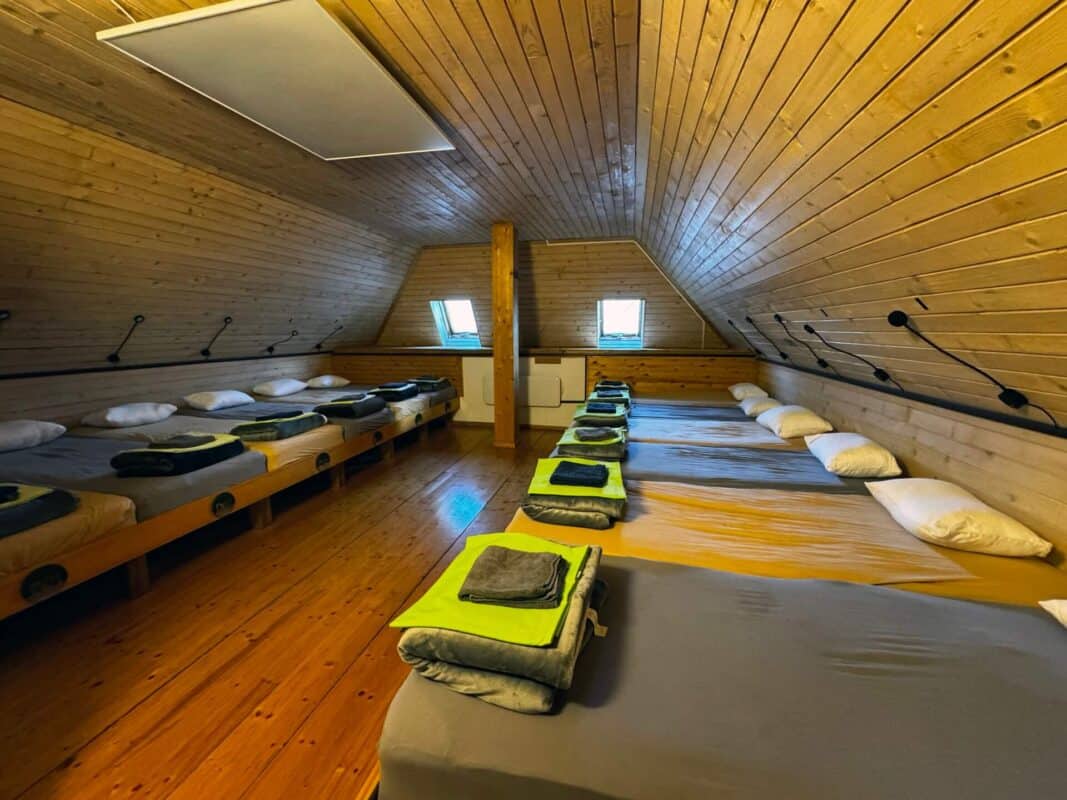
✓Simple mountain-hut comfort and shared house rules
✓Direct access to Vršič, trails and Triglav National Park
×Do not expect
×Hostel-style nightlife or loud late evenings
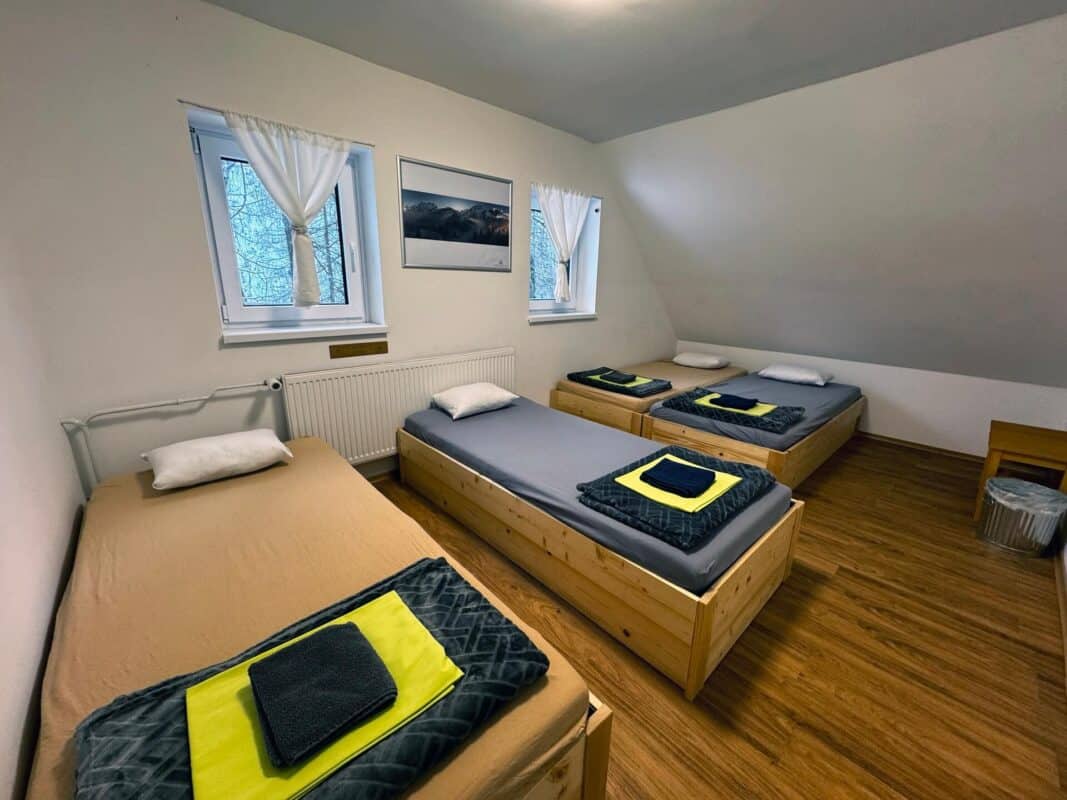
×Private bathrooms in every room
×Unlimited parking or guaranteed road access in every weather
×Perfect silence during busy mountain days
Stay on Vršič Pass
Stay at Erjavčeva koča on Vršič Pass
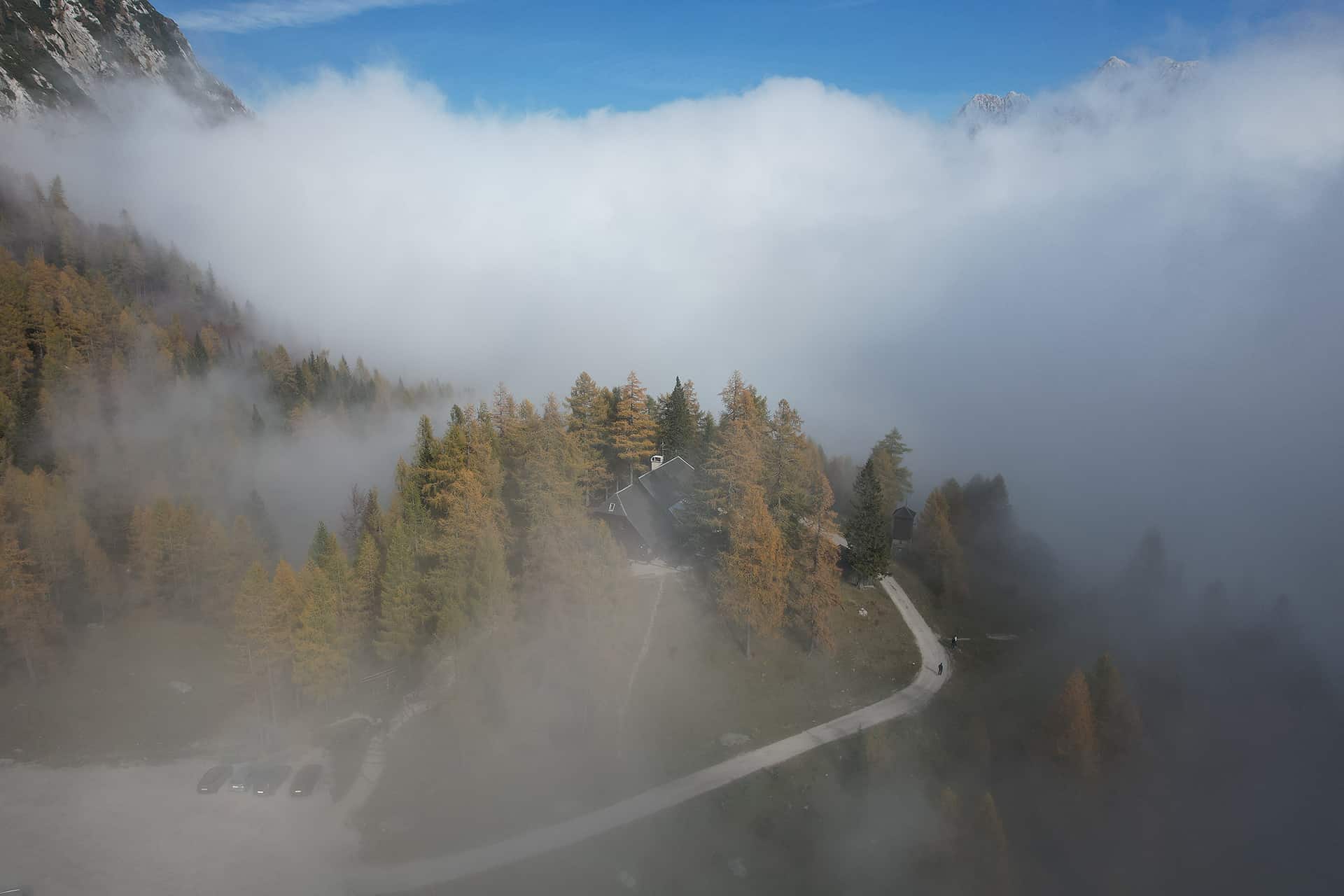
Erjavčeva koča is a mountain hut at Vršič Pass, between Kranjska Gora, Trenta, the Soča Valley and the Julian Alps. It is a practical base for hikers, road-trippers, cyclists and guests who want to stay close to the mountain pass.
Direct location on the Vršič Pass road
Good base for hiking, scenic drives and Julian Alps day trips
Useful for guests visiting Kranjska Gora, Trenta, Soča Valley and Triglav National Park
Food, mountain-hut atmosphere and practical local information in one place
This block is designed for independent guests and self-service booking. It does not imply a price guarantee or live availability.
Before you book your stay
Vršič Pass is a high mountain location, so it is worth checking a few practical details before you travel. This helps you plan your arrival, parking, hiking day and overnight stay more easily.
Access and road conditions
The Vršič road can be affected by season, weather and traffic. Before travelling, check current access information and plan enough time for the mountain road.
Parking
Parking rules and availability around Vršič can change by season and operator. Check the latest parking information before arrival, especially in busy periods.
Rooms and overnight stay
If you plan to stay overnight, check room availability in advance. This is especially important during the hiking season, weekends and good-weather periods.
Food, opening hours and groups
Opening times may vary outside the main summer season or by arrangement with groups. Contact the hut directly for the latest information before making fixed plans.
Self-service planning for your stay at Vršič Pass
Check room and availability options first.
Read access, parking and arrival notes before travelling.
Arrive with your own plan for Vršič, Kranjska Gora, Trenta and the Soča Valley.
Use contact only for special cases, not for information already explained on the page.
A trusted mountain hut at Vršič Pass
Erjavčeva koča has been part of the Vršič mountain pass experience for generations. Guests use it as a practical alpine base for hiking, cycling, scenic drives, visits to Kranjska Gora and trips toward Trenta and the Soča Valley.
Use the booking information on this page to decide independently. Booking platforms can help with comparison, but your reservation should be clear before you travel. Contact is only for special cases.
Direct booking is best for
Checking rooms and availability
Reading access, parking and arrival details
Booking when your dates and plan are clear
Special questions only for groups, late arrival or winter conditions
No price guarantee is implied. This block encourages self-service planning and reduces unnecessary calls or emails.
What happens after you check availability?
Checking availability is the first booking step, not a request for personal travel planning. Read the arrival, access and parking information before you book. Contact is only for special cases.
Choose the room or stay option that fits your plan.
Complete the booking request with your travel date and arrival plan.
Before travelling, read the access, parking and seasonal notes; use contact only for groups, late arrival or winter conditions.
CTA clicks are measured as intent signals. This block is designed for self-service reservations and to reduce unnecessary calls or emails.
Summer visit: parking, hiking and rooms
In summer, Vrsic is busy with hikers, cyclists and scenic-road visitors. Plan arrival time, parking, weather protection and overnight questions before you leave.
Arrive early when parking demand is high.
Check weather before longer hikes.
For overnight stays, contact the hut directly before travel.
This block is a practical planning reminder, not a live availability statement.
Last updated: 08/02/2026First published: 08/01/2026Reading time: 12 min readPrepared by: Erjavčeva koča team
Mountaineering in a New Era (1946)
Mountaineering in a New Era (1946)
Mountaineering in a New Era (1946)
Mountaineering in a New Era (1946)
The beauty of our mountains has, from time immemorial, attracted numerous visitors who sought in them rest from hard daily life, as well as the peace and quiet needed by a healthy and noble human spirit. Through their influence and power, the mountains have already been a formative factor worth considering. Today, their importance is becoming even greater. With the inclusion of mountaineering in the physical culture organisation, love for the mountains—and the help that the mountains provide in shaping the new human being—also becomes a collective asset, a means of educating the broadest circle of participants in physical culture.
Mountaineering in a New Era (1946)
Mountaineering in a New Era (1946)
By its significance and its mode of practice, mountaineering does indeed differ from other branches of physical education. Yet by its very purpose and effect, it ranks among the main factors of our physical education. All preparation, training to overcome natural obstacles, and the strengthening of perseverance, determination, and courage require extensive preliminary preparation; they demand comprehensive physical fitness and, therefore, the cultivation of all those branches of physical education which together constitute a true system of new physical education.
And that is not all. Mountaineering does not consist only of ordinary and mass visits to the mountains. It also encompasses top-level feats that require special preparation, special courage, and the greatest effort. This links it with the sporting mode of practising other branches of physical education and, precisely through this, creates harmony between mountaineering and physical culture as a whole.
It would, of course, be a mistake to assess the importance of mountaineering today if we attempted to incorporate it into the new physical education in a way that would deprive it of its old beauty, or if we were to include it as a separate discipline in a manner that would strip it of its deeper content. It is precisely through the specialised content that it differs from other branches of physical culture, and therefore, it also requires a specialised structure and care. The distinctive content of mountaineering lies in its unique effect on the human spirit—its contribution to the formation of human nobility, to the development of a sense of beauty, and thus in the special emphasis it places on the spiritual dimension of its influence.
Such a view of mountaineering also requires that it be directed toward genuine mass participation. Every participant in physical culture must love our mountains. Through them and in them, one must come to know the beauty of nature. In their embrace, one must shed narrow-mindedness and, as a new human being, contribute to the new life that we are today building with full determination on the ruins of the old world. Workers and youth must become the foremost lovers of our mountains. Since they are the bearers of physical education in general, they must also be the strongest shapers of a new spirit and new traditions in exploring our mountains, in seeking their beauty, and in creating perfect harmony between mountaineering and physical education.
Unity, harmony, and mutual understanding are the firm foundations of new successes; they are the first commandment in the work toward a happy future and thus also the sole guarantee of the success of mountaineering.
Zoran Polič, Minister of the FLRS
Mountaineering in a New Era (1946)
The Central Pillar of Rogljica
In 1938, during a conversation about walls we had not yet climbed, my companions Joža and Miha mentioned the central pillar of Rogljica. They said that several climbing parties, both local and foreign, had already inspected this line, that attempts had been made, but that each time they had turned back. I hinted to Joža that perhaps we should take it on ourselves, but he cut me short, saying he already had enough rheumatism and that bivouacs on walls were therefore not at all to his liking. He did, however, encourage me to try with Maks, adding that it was important for locals to make the first ascent—otherwise foreigners would beat us to it.
From then on, the pillar truly began to occupy my thoughts. Once, I examined it thoroughly with binoculars from the wall of Razor, but I could not discern a viable line. Everywhere there were smooth slabs and overhangs. The following spring, Maks went off to military service, but when he returned in September, the two of us first headed into the west face of Škrlatica, specifically to examine the Rogljica pillar up close. Yet again, the result was the same: it seemed impossible to force a passage across the smooth slabs. We no longer wondered why all the previous rope teams had been compelled to retreat. Serious preparation would be necessary.
It was not until the summer of 1940 that we finally decided to go for it—Maks and I, and we also invited Ariha. By then, Miha had become quite a climber as well. On Saturday, 26 July, he waited for Maks and me at the railway station in Kranjska Gora. Together we set off into Krnica, paused only briefly at the hut, and then continued toward Velika Dnina. We had to keep moving, as the bivouac was still far away.
Along the way, our gazes kept drifting to the walls of Rogljica. Silently, each of us privately wondered what the next day would bring. Beneath the west face of Škrlatica, we stopped; the sun was already sinking toward the horizon, and evening shadows spread across the wall. Somewhere in a chimney, water gurgled dully. Darkness fell over Krnica, an owl called beneath Vršič, and from Erjavčeva Hut a shout briefly cut through the silence before dying away among the scarred walls of Krnica. We continued on and reached the bivouac at dusk. The stove hummed, and then Maks and Miha began preparing the sleeping places. I myself did not crawl under the roof; the beautiful summer night lured me outside. The sky was washed clean. Pale light began to bathe the opposite peaks and ridges, slowly sliding down the slopes into the valley floor. Indescribably beautiful is the view of that mountain chain from Razor to Jalovec when the moon illuminates it on clear nights. All too soon, I had to tear myself away from this splendour, for we had to be on our feet early in the morning.
Mountaineering in a New Era (1946)
At half past three, Maks was already making tea, while Miha and I tidied the bivouac. As we crossed the scree beneath Škrlatica, the first sunlight was already lighting up the summits. We hardly knew how we found ourselves in the gully beneath Rogljica, where our route began. We put on our climbing shoes and tied into the rope. Miha and I took the ends, with Maks, a reliable belayer, in the middle. We shook hands warmly, and then I set off first, climbing upward along a smooth, stepped crack. I moved quickly over ledges, and all too soon, Maks called up that the rope had run out. The spot where I stood was unsuitable for belaying, so the others had to climb a few meters higher before I could settle safely into a small groove. Soon we were all together again. But where now? Above us was an overhang; to the right were smooth slabs. It was Miha’s turn; he decided to try across the slabs. I belayed him from the groove, while Maks spotted him as he friction-climbed upward, trying to reach a small fissure where he could drive in a piton. He succeeded, but the piton went in barely a centimetre. There was no alternative: it served him as a tenuous support as he climbed higher to reach the edge of the slab. Only a few centimetres were missing from the hold when—rrrsk!—he slipped on the slab. Fortunately, the piton held, and Miha did not lose his nerve. He pulled himself back and tried again. This time, he had more luck; soon, he was across the slab and on a solid stance, allowing Maks and me to follow quickly.
From there, we moved together to a large gully and then along a narrow ledge to the right beneath a ridge. A ten-meter-high overhanging step blocked our way. This time I led. After the first attempt, the wall repelled me. Neither footholds nor handholds would hold; the rock crumbled as if being ground away. “Rogljica is defending itself well—already at the start it’s pushing us back!” The second attempt went better, but about eight meters up, I found myself hanging beneath the hardest section of the overhang. I couldn’t place a piton; everything flaked and broke. Miha and Maks watched tensely, ready to hold me if I fell, at least onto the ledge. Suddenly, I heard a voice from below: “Janez, step!”—and at that moment the rock gave way under my left foot. At the same time, the handhold in my right hand tore loose, leaving me literally hanging on the wall. The immense strain on the fingers of my left hand disoriented me for a moment, but in the next instant, I grabbed a new hold with my other hand and slowly pulled myself upward. Any hesitation in such a place would have been fatal. I reached the edge of the overhang and the ledge above it. My first glance went down to my companions; Miha had been struck in the leg. When I was knocked loose, he had lunged forward to catch me if I fell headfirst, and in doing so, a rock fragment hit him.
From the ledge, we continued through easier terrain together to a buttress near a window-like opening. Then we descended slightly to the right into a gully and climbed straight up across smooth, steep slabs. Above the twenty-meter-high slabs, we found ourselves once again on a ridge. Soon we stood beneath an enormous, nearly hundred-meter-high overhanging pillar. Where next? The only possible passage lay on slabs leaning against the wall on our right. I tried it—and it went—but I had the feeling that at any moment everything, together with me, might crash down into the valley. Along a narrow line, I then climbed up to a small headwall, drove in a piton, and waited for my companions. It was one o’clock in the afternoon.
In the narrow space between sky and earth, we quickly ate some food. Meanwhile, fog rolled in from the direction of Špik, thunder rumbled several times, and soon the sky began to shower us with its “blessing.” Waiting it out was not an option, and we also had little time to spare, so we decided to continue. Miha, now leading, had to drive in six pitons for just a few meters of height. Twice, the rock crumbled away; the second time, it nearly struck Maks directly on the head. Fortunately, it only grazed him. Miha tirelessly hammered in pitons and climbed upward very slowly. It took him a full hour to reach the ledge atop the pillar. I went last and removed the pitons. As I was pulling out the last one, after a few hammer blows, it suddenly slipped cleanly out of the crack, and at the same time, the entire flake detached from the wall by several centimetres. I did not hesitate—such an ugly block can easily drag you down.
From the ledge onward, the terrain eased again, and we were able to move together to a large, crooked chimney. The rain stopped. I led once more. The chimney did not appeal to me much. Along the ledge, I stepped to the edge to look around. There, right next to the ridge, was a grooved chimney that tempted me. At the top, it was blocked by jammed boulders, but I hoped to find a way past them. The chimney went reasonably well, though I could not place a single piton for protection. Beneath the top, braced on a poor stance, I stretched out my right hand to test the stability of a jammed rock. The rock shifted as soon as I touched it. I was in an extremely awkward position. I could not retreat without risking a fall, and none of my companions could help me. The abyss yawned terribly beneath me; from that dizzying height, I stared straight down into the scree at the base. There was little time for deliberation. I had to decide quickly on a move to get out of the predicament. With my hammer, I began chiselling a small step into the wall beside the chimney. Once I had carved it out, I placed my right foot on it, lunged upward, and grabbed the edge above the jam. Hollow rumbling echoed in the groove; some stones cascaded down the chimney, but I safely reached a position from which I could belay my companions.
It was already five in the afternoon. The summit could not be far, as we were already above the saddle between Rakova Špica and Rogljica. Clouds gathered again; a storm raged nearby. We hurried all together to avoid unnecessary delay. Still, the wall would not release us cheaply. Another pillar blocked our way just below the summit. It troubled Miha somewhat, but with the help of pitons, he soon overcame it. One more rope length upward—and we were on the summit. The heartfelt clasp of hands said more than words ever could. Each of us knew that together we had accomplished a fine climb. We had overcome several extremely difficult sections that demanded much of us. The awareness of victory was our reward.
As we were putting on our boots, Miha and I wondered where all the cobwebs up there were coming from. The more we brushed them away, the more there seemed to be. A look at Maks cleared up the mystery. He was uncovered, and his hair was standing on end—then we knew where the “cobwebs” came from. The air was saturated with electricity, and we were carrying quite a bit of iron. Hence the sensation. We did not linger, knowing the storm could break at any moment. Below the summit, we parted ways: Miha descended via the Kriška wall into Krnica, while Maks and I headed at full speed toward Aljažev Dom. Since we intended to get home that same evening, we continued toward Mojstrana straight into the storm. Around Škrlatica, it thundered as if the rocks themselves were breaking apart. I could not reconcile myself with the thought of having to bivouac somewhere up there in such conditions. Joža Čop (archive) is right after all—at least as far as rheumatism is concerned.
We are located in the heart of Triglav National Park
Book a stay in the iconic, first-built mountain hut on the Vršič Pass
Erjavčeva mountain hut is open year-round. Reserve your stay and spend some time in the natural paradise of Triglav National Park (UNESCO), near Kranjska Gora, on the Vršič mountain pass in the heart of the park.
We use cookies to improve your browsing experience, measure traffic, and enhance website functionality. You can accept all cookies, reject non-essential cookies, or manage your preferences. Cookie Policy,
Privacy Policy
and Terms of Use.
!
Google Maps displays incorrect information that the road to Erjavčeva koča is closed. The road to Erjavčeva koča is open and normally passable from both directions.


 Slovenščina
 Bosanski
 Hrvatski
 Čeština
 Dansk
Dansk Dutch
Dutch Suomi
Suomi Français
 Deutsch
 Magyar
 Italiano
 Polski
 српски
 Slovenčina
 Español
 Svenska